Real session tools for substance use counseling that reduce power struggles,
strengthen relapse prevention, and make documentation faster.
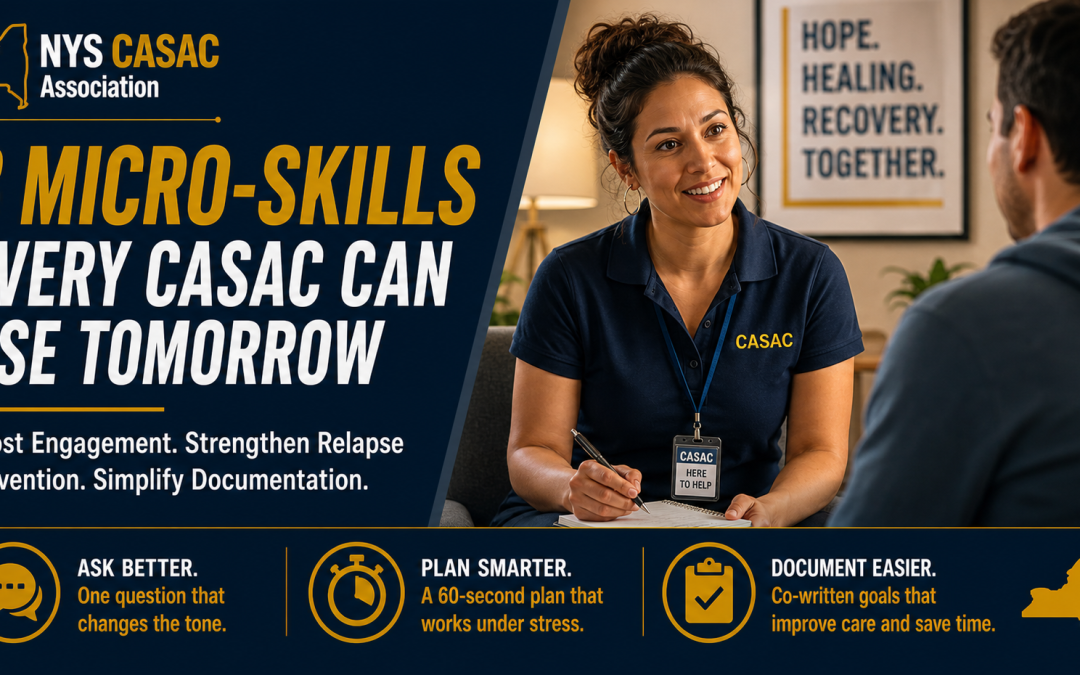
You don’t need another training filled with ideas you’ll never use. Instead, what you truly need is focused guidance on substance use counseling engagement, practical, effective techniques that work under pressure, with real clients, in real time. As a CASAC, your role isn’t to simply “convince” people to change. Your primary responsibility is to foster engagement, reduce risk, and transform chaos into a structured plan that the client will actually implement. Mastering these three micro-skills will help you achieve that, and you can start applying them as soon as tomorrow.
1) A substance use counseling engagement question that changes the tone
Ask this early. Ask it out loud:
“What would make this worth your time today?”
This question is a clinical shortcut. It helps you skip the power struggle and get straight to what matters.
It signals respect. You’re telling the client they’re not here to be lectured or fixed. They’re here to get something useful. That lowers defensiveness immediately.
It turns the session into a collaboration. Instead of you guessing the goal, the client names it. That’s how you get buy-in into substance use counseling engagement
It gives you high-value clinical data. Their answer tells you what the brain is trying to regulate right now: cravings, sleep, anxiety, stress, housing instability, court pressure, family conflict, shame, or the simple need to feel normal for one hour.
If they say “nothing,” don’t debate it
Use it as information, not disrespect. Then follow with one of these:
- “Fair. If you walked out of here and it was a total waste, what would we have done in this session?”
- “If it were even 10% helpful, what would be different when you leave?”
- “Do you want practical steps today, or do you want to be heard first?”
This keeps the client in the driver’s seat while you quietly steer toward engagement. You are not begging for participation. You are building it.
2) The relapse prevention move that works under stress
Most recovery plans fail because they are too broad and overly optimistic. They often outline an ideal week that doesn’t account for real-life challenges. Recovery from substance use is a brutal process that can change in an instant. Instead of trying to map out the entire week, it’s more effective to focus on the first 60 seconds, which are often the most vulnerable. This is the danger zone, the time when the brain flips into autopilot and old habits resurface. Without a specific plan for those critical first moments, sustaining progress becomes nearly impossible. Engaging consistently in substance use counseling and having a clear plan for those initial seconds can make all the difference. Substance use counseling engagement during this crucial period helps build resilience and ensures that individuals are better prepared to confront and navigate the immediate, high-risk moments that threaten their recovery.
Run it like a drill in session
Step 1: Name what causes the trigger:
Ask: “What’s the moment it usually starts?”
Not the whole background story. The first spark: a text, a route home, payday, boredom at 9 pm, a fight, a certain corner store.
Step 2: Name the first body signal
Ask: “What do you feel first?”
Tight chest. Restless legs. Hot face. Numb. Irritated. Empty. Stomach drop.
Step 3: Name the first thought
Ask: “What does your brain say?”
“Just one.” “I deserve it.” “Nobody cares.” “I can’t handle this.” “I already blew it.”
Step 4: Build the 60-second script
Pick three actions that take under one minute total and require no special tools. Examples:
- Stand up and change rooms immediately
- Cold water on hands or face
- Text one person a single word: “NOW.”
- Open the notes app and read the slip plan
- Put keys and wallet in a different place
- Step outside and do 10 slow breaths
Step 5: Rehearse it
Don’t talk about it. Rehearse it.
Say: “Show me how you’d do it right now.”
Have them physically stand, move, text, breathe, or read the script.
If they can’t do it with you in a calm room, they won’t do it at midnight in a parking lot.
Do this until the practice becomes muscle memory and a new normal.
3) The documentation move that lowers stress and improves care
If your notes are taking up your evenings and making the process of substance use counseling engagement feel overwhelming, you don’t need to add more guilt. You need a better method. Here’s a simple move to improve your documentation and client interaction: write the goal with the client during the session itself. Avoid jotting down notes afterward, relying solely on memory, or using language that the client would never use themselves. Instead, collaborate in real-time during the session, capturing the goal in their words. This approach not only streamlines your note-taking process but also enhances the authenticity and engagement in substance use counseling, ensuring that the client feels heard and understood while you maintain accurate, meaningful documentation.
Use this exact language
- “Let’s write your goal in your words.”
- “If you read this later, it should sound like you.”
- “What’s one change you actually want this week?”
Then make it measurable in 30 seconds:
- “How many days?”
- “What’s the smallest version of that goal you can do?”
- “On a scale of 0–10, how confident are you?”
- “What would move it one point higher?”
Now your documentation does three things at once:
- Captures real clinical intent
- Increases client ownership because it’s co-written
- Reduces documentation stress because the hardest part is done before the client leaves
It also protects you. Co-written goals reduce ambiguity and reduce “I never agreed to that” conflict later. That matters for accountability, supervision, audits, and continuity of care.
Collaborative documentation makes note-taking simple. You finish the note with the client in the last 5 minutes of the session. Everything about the session and a plan for your next meeting is established. Collaborative documentation increases engagement in substance use counseling.
Conclusion
These are practical, field-tested micro-skills you can apply in real sessions. Start by asking, “What would make this worth your time today?” to shift the tone and strengthen engagement in substance use counseling. Then improve relapse prevention by mapping the first 60 seconds and rehearsing a simple action script. Finally, prioritize collaborative documentation by co-writing the goal in-session in the client’s words and making it measurable. Use these consistently and you’ll improve follow-through, reduce risk, and document care more accurately.
Join the NYS Association of CASAC Professionals.
Advance your career. Unify with peers. Advocate for the profession. Gain access to training, certification support, and a statewide network that strengthens both you and the CASAC workforce
Stay Connected With NYS-CASAC Association NEWS
Don’t miss the updates, spotlights, and resources shaping addiction counseling in New York. Join the NYS Association of CASAC Professionals today for full access to announcements, newsletters, and advocacy news that strengthen your voice and career.