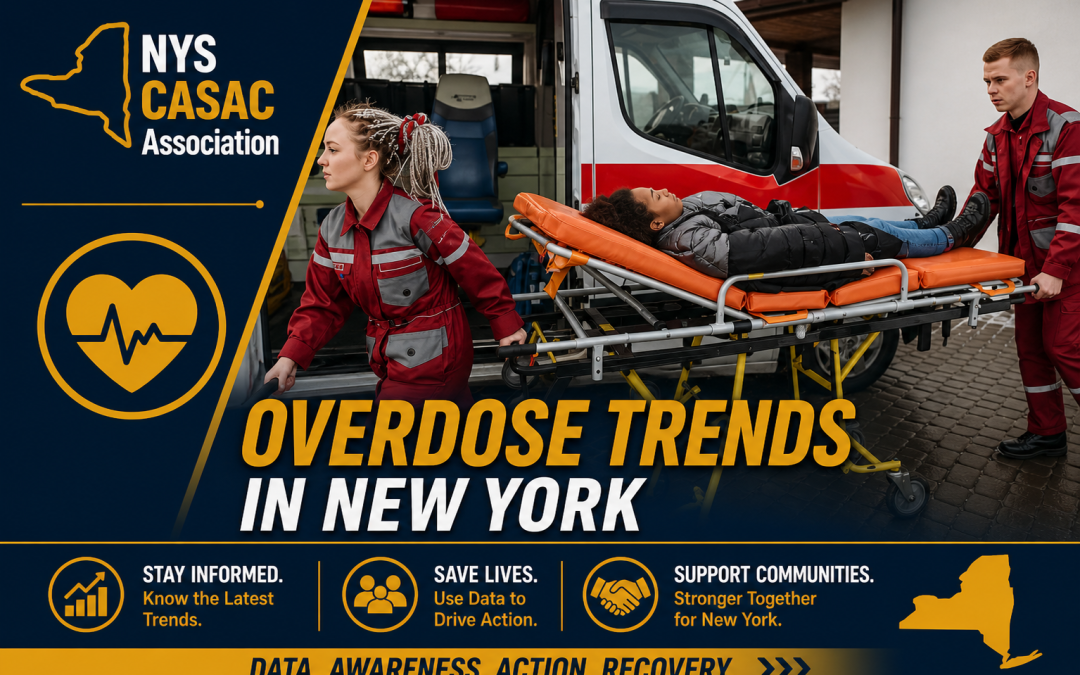
Overdose Trends in New York: What the Latest Data Means to SUD Treatment
Let’s talk about what’s actually happening on the streets, not just what people tweet about.
According to multiple state reports, New York’s overdose landscape has shifted. After years of grim record highs, preliminary data show a significant decline in fatal overdoses in 2024 compared with 2023, including fewer opioid-driven deaths statewide. That drop didn’t happen by accident — it tracks with real investments in harm reduction, naloxone access, and expanded outreach programs.
Even so, the drug supply is still unpredictable and dangerous. Fentanyl remains involved in the vast majority of overdoses, and xylazine (a non-opioid sedative often mixed with fentanyl) continues to be detected more frequently, both locally and nationally.
Fentanyl, Xylazine, and What CASACs Are Seeing
Every time you ask, “What was in the client’s supply?” the answer matters more now than ever.
-
Fentanyl is still present in a huge share of overdoses, showing that illicitly manufactured opioids drive the crisis. Available data show that it was in around 80 percent of overdose deaths in New York City alone in 2023.
-
Xylazine, unlike fentanyl, does not respond to naloxone alone and is increasingly a part of the street supply across the Northeast. Having this sedative in the mix increases risk and complicates rescue efforts.
Testing the actual drug before use can save lives, and test strips for both fentanyl and xylazine are widely distributed across the state as part of New York’s harm reduction efforts.
Regional “Hot Spots” & Uneven Patterns
Even as overall overdose deaths fall, the picture isn’t uniform.
Statewide dashboards maintained by the New York State Department of Health show county-level differences in overdose hospital visits, EMS responses, and naloxone administration. These patterns change over time, indicating which communities need targeted focus.
For example, public health reporting reveals that while deaths declined overall in 2024, specific neighborhoods and high-poverty areas still face starkly elevated overdose rates, particularly in NYC boroughs.
That means your frontline practice must stay responsive because local variation matters more than “statewide averages” when you’re walking into a crisis room or community outreach event.
Ground-Level Picture: What Clients Are Using
Your clients aren’t just using “opioids.” They’re using rotating blends of chemicals:
-
Illicitly manufactured fentanyl
-
Fentanyl analogues
-
Xylazine-adulterated products
-
Other synthetics mixed with stimulants
These aren’t peripheral trends. They’re the norm.
That’s why drug checking, using test strips and other tools, is becoming a standard part of harm reduction practice. If a client says “it’s just heroin,” but a test strip lights up for fentanyl or xylazine, you have real, actionable information that changes how you talk about risk in that moment.
Harm Reduction in Action: Naloxone, Test Strips, and Outreach
New York is investing in tools that save lives, and CASACs are central to that effort.
Programs across the state have distributed millions of fentanyl and xylazine test strips and hundreds of thousands of naloxone kits to people who use drugs, their loved ones, and community partners.
These resources are available at no cost, and you can learn more or help clients get supplies through the state’s official harm reduction pages:
🔗 NYS OASAS Harm Reduction Programs
🔗 New York Opioid Data Dashboard
Remember: naloxone works on most opioid-involved overdoses, but additional life-saving actions (like rescue breathing) should be added when xylazine is suspected because naloxone alone won’t reverse every case.
What overdose trends in New York to you as a CASAC
Data without action is just numbers.
As a CASAC, your role isn’t just clinical; it’s street-level survival work.
Here’s what matters on the ground:
1. Ask about drug supply and testing.
Does your client have access to test strips? Have you integrated that question into your intake or harm reduction check-ins?
2. Normalize naloxone availability.
Help clients and families carry naloxone. Teach them how to use it. Offer to practice with them.
3. Meet them where they are.
People won’t always show up in a clinic. Outreach, education, and practical tools are treatments too.
4. Know your community hotspots.
Use the NYS Opioid Data Dashboard to map patterns and tailor outreach or prevention plans.
5. Break down stigma around testing and checking.
Asking about drug checking isn’t judgment; it’s harm reduction.
Final Thought
Overdose trends in New York are shifting, and the work you do is literally what saves lives.
Yes, deaths may be declining overall.
Yes, the drug supply is more complex than ever.
But every client interaction carries real-world stakes, and the more you know, the better you can act.
Knowledge is power, but preparedness is survival.
If you want, I can turn this into newsletter blurbs, social cards, or your next training topic.
Just say when.
Join the NYS Association of CASAC Professionals.
Advance your career. Unify with peers. Advocate for the profession. Gain access to training, certification support, and a statewide network that strengthens both you and the CASAC workforce
Stay Connected With NYS-CASAC Association NEWS
Don’t miss the updates, spotlights, and resources shaping addiction counseling in New York. Join the NYS Association of CASAC Professionals today for full access to announcements, newsletters, and advocacy news that strengthen your voice and career.