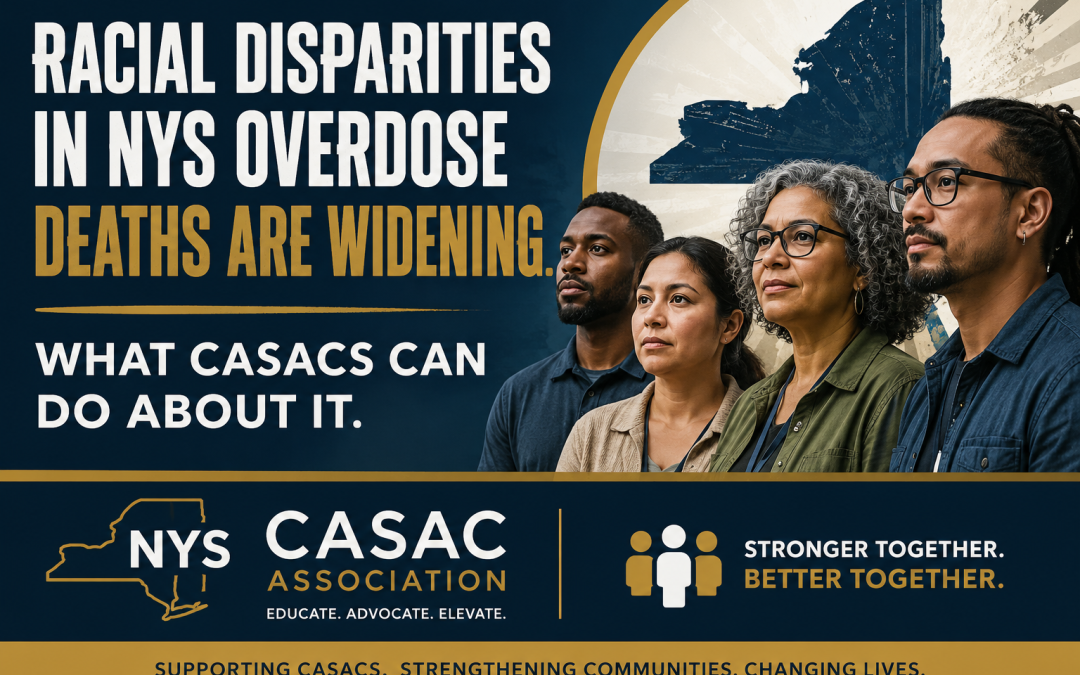
Racial disparities in drug poisoning deaths remain across New York, even after the statewide decline. CASACs need a grounded clinical response.
New York’s Drug Poisoning Deaths Fell. The Racial Gap Remains.
A counselor hears the statewide numbers and feels relief.
Deaths fell. Naloxone distribution expanded. More people survived.
Then the client sitting across from them describes three losses in one year.
Same city. Same neighborhood. Same circle.
The statewide trend is real. So is the unequal burden.
New York recorded an estimated 4,567 drug poisoning deaths in 2024, down from 6,688 in 2023. That works out to a decline of nearly 32 percent. The current OASAS overdose death dashboard reports the change as a 30 percent statewide decrease, using rounded figures.
That decline matters.
It does not mean every community benefited equally.
The numbers improved, but the gap stayed
OASAS reports that deaths declined by about 30 percent among Black, White, and Hispanic or Latino New Yorkers. American Indian and Alaska Native New Yorkers saw a reported 40 percent reduction.
The same dashboard reports that Black New Yorkers still had the highest death rate in 2024. American Indian and Alaska Native New Yorkers followed, then Hispanic and Latino New Yorkers.
That distinction matters.
Equal percentage declines do not erase unequal starting points. A community with a much higher death rate can improve and still carry the heaviest loss.
The statewide picture is progress.
The racial gap remains unfinished work.
These disparities did not begin in 2024
New York’s own overdose prevention reporting describes a longer pattern.
From 2018 through 2022, death rates rose 265 percent among Black non Hispanic New Yorkers. Rates rose 115 percent among Hispanic New Yorkers. The increase among White non Hispanic New Yorkers was 36 percent during the same period. By 2021, Black and Hispanic New Yorkers had moved above White New Yorkers in recorded death rates.
That is not a difference in motivation.
That is a difference in exposure, access, and protection.
The New York State Interagency Task Force on Overdose Prevention links racial disparities to long standing barriers in treatment and medical care. It reports that those barriers worsened during the pandemic.
The drug supply matters.
So do the systems surrounding it.
Harm reduction access is not equal
New York has expanded access to naloxone, test strips, mobile services, and medication. OASAS reports distributing more than 26 million drug testing strips and 406,000 naloxone kits.
Those numbers show scale.
They do not prove equal reach.
A service can exist statewide and still remain hard to access locally. Transportation fails. Pharmacy stigma appears. Program hours conflict with work. Language access breaks down. Police presence makes outreach feel unsafe. Rural distance adds another barrier.
Then the counselor says, “Naloxone is available.”
Available where?
Available to whom?
Available under what conditions?
The OASAS Council for Treatment Equity was created to examine economic, physical, social, and cultural barriers affecting treatment access. Its charge includes reviewing policies that block equity and building community involvement in racially diverse areas.
That work belongs inside clinical practice too.
Cultural humility is not memorizing facts
Cultural humility starts with a basic presupposition.
You do not know the client’s full experience.
Race does not tell you how someone thinks. Culture does not operate like a checklist. Shared identity does not erase class, gender, age, religion, immigration history, neighborhood, family roles, or past contact with institutions.
So ask.
What has treatment been like for you before?
What made it hard to trust providers?
Where do people in your community go for help?
Have you had trouble getting naloxone or medication?
What happens when you ask for pain treatment?
What makes a program feel unsafe?
Then listen without defending the system.
That is cultural humility in practice.
Assessment must include access
A standard substance use assessment often focuses on frequency, quantity, withdrawal, prior treatment, legal pressure, housing, and medical risk.
Keep those questions.
Add access.
Ask about transportation. Ask about pharmacy treatment. Ask about insurance gaps. Ask about prior discrimination. Ask whether the client has received medication for opioid use disorder when requested.
A referral is not complete when you hand someone a number.
Confirm the hours. Confirm intake rules. Confirm language access. Confirm transportation. Confirm whether the program accepts the client’s insurance.
Refer. Check. Follow up.
That is where traction begins.
Do not confuse mistrust with resistance
A client declines a referral.
A counselor writes “resistant.”
That word can hide ten separate problems.
The client had a racist encounter at that hospital. The program discharged them after a missed appointment. Security searched them in front of others. A provider dismissed their pain. A pharmacy refused medication.
Mistrust can be learned.
A better note describes the reason.
“Client declined referral after reporting prior discriminatory treatment at the facility. Counselor reviewed two alternate programs and discussed transportation.”
That note gives the next counselor something useful.
It also keeps bias out of the record.
Harm reduction must fit the client’s setting
Generic advice fails fast.
“Do not use alone” means little for someone living alone.
“Carry naloxone” does not solve a pharmacy refusal.
“Use test strips” requires access, privacy, water, supplies, and knowledge of limitations.
Build the plan around the person’s actual setting.
Where do they use?
Who can check on them?
Can they use a phone-based safety service?
Where can they get supplies without judgment?
Who in their family needs naloxone training?
EECO’s guide to harm reduction in drug counseling gives counselors a practical way to discuss risk without demanding immediate abstinence. That frame fits clients who have been pushed out of treatment by rigid rules.
Representation matters, but it is not the whole answer
A diverse workforce can improve trust and communication.
It does not remove the need for training, supervision, and accountability.
A counselor can share a client’s racial background and still miss class differences, gender experience, trauma, neighborhood history, or distrust of institutions.
Shared identity is not automatic competence.
The NAADAC ethics standards for work in a culturally diverse world require counselors to examine bias, respect cultural differences, and practice within their competence. NAADAC places this responsibility inside professional ethics, not personal preference.
Supervision should ask direct questions.
What assumptions entered the assessment?
Did the counselor label caution as resistance?
Did the referral match the client’s community?
Did the program offer real choice?
Was the client heard?
CASAC cannot fix structural racism alone
Counselors do not control housing policy, Medicaid rates, pharmacy deserts, policing, or settlement funding.
You still control parts of the encounter.
You control your language.
You control whether you believe the client.
You control whether you check the referral.
You control whether you bring patterns into supervision.
You control whether repeated barriers become data or disappear inside separate charts.
The NYS CASAC Association practice resources connect counselors with guidance on harm reduction, cultural competence, ethics, and current state policy. Those resources matter most when they change what happens in the next session.
Start with one access question
Racial disparities in drug poisoning deaths will not close through awareness alone.
They close through changed practice, targeted funding, trusted outreach, medication access, and accountability.
Start with one question during your next assessment:
“What has made it harder for you to get help?”
Do not rush the answer.
That answer may tell you more than the referral list.
Join the NYS Association of CASAC Professionals.
Advance your career. Unify with peers. Advocate for the profession. Gain access to training, certification support, and a statewide network that strengthens both you and the CASAC workforce