
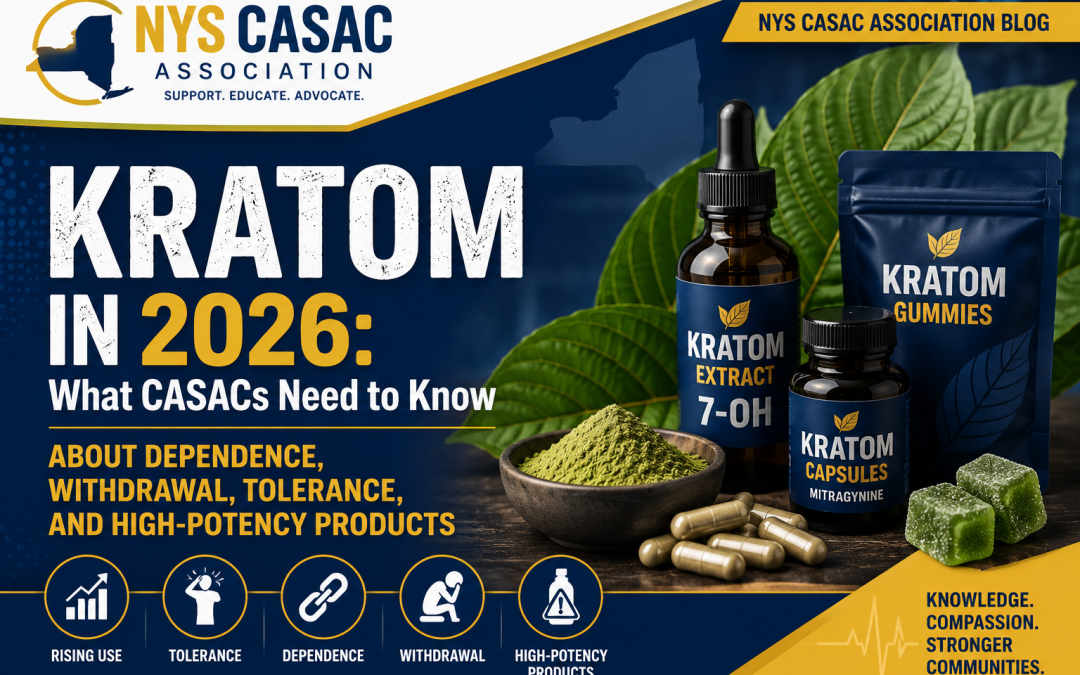
Kratom in 2026: What CASACs Need to Know About Dependence, Withdrawal, Tolerance, and High-Potency Products
Five years ago, most substance use counselors in New York barely heard clients mention kratom.
Now it is everywhere.
Gas stations. Vape shops. Convenience stores. Wellness websites. Social media ads promising “natural energy,” “focus,” “pain relief,” or “opioid recovery support.”
And more clients are walking into treatment already using it.
That matters because the kratom market in 2026 is not the same market people were talking about ten years ago. The products are stronger. The extracts are more concentrated. The marketing is more aggressive. And many people using it do not fully understand the risks involving tolerance, dependence, and withdrawal until they are already stuck in the cycle.
As CASACs, we need to stop viewing kratom as a fringe issue. This is becoming a real part of the modern substance use landscape.
Kratom Use Is Rising Fast
Research from the Recovery Research Institute found that kratom use is rising significantly across the United States, especially among younger adults and individuals already using other substances.
That trend should not surprise anyone working in behavioral health.
People are looking for:
- Pain relief
- Anxiety relief
- Energy
- Sleep support
- Mood regulation
- Alternatives to opioids
And kratom is being marketed as a safer, “natural” option.
The problem is that “natural” does not automatically mean safe.
Tobacco is natural.
Opium is natural.
Poison ivy is natural.
Kratom contains active alkaloids, primarily mitragynine and 7-hydroxymitragynine, that interact with opioid receptors and other systems in the brain. According to the National Institute on Drug Abuse (NIDA), kratom can produce stimulant-like effects at lower doses and sedative effects at higher doses.
That combination is part of why some people initially feel it “helps.”
It is also why tolerance and dependence can develop.
Tolerance: When “Just a Little” Stops Working
This is where many clients start sliding deeper into the pattern without realizing it.
At first:
- One capsule works
- One tea works
- One shot works
Then it doesn’t.
Tolerance develops as the body adapts to repeated use, leading a person to need larger amounts to achieve the same effect. Cardinal Recovery describes this pattern as increasingly common among regular kratom users, especially those using extracts or concentrated products.
You start hearing:
- “It used to work better.”
- “I just need a stronger one.”
- “The regular powder doesn’t hit anymore.”
This is not harmless experimentation anymore.
It is the beginning of the physiology of dependence.
And newer products on the market accelerate this process.
Dependence and Withdrawal Are Real
One of the biggest myths floating around online is that kratom does not produce withdrawal.
That is false.
The American Addiction Centers notes that regular kratom use can produce physical dependence and withdrawal symptoms that resemble mild-to-moderate opioid withdrawal in some individuals.
Clients may experience:
- Anxiety
- Irritability
- Insomnia
- Restlessness
- Muscle aches
- Sweating
- Nausea
- Depression
- Intense cravings
Some people also report emotional instability and difficulty functioning when trying to stop.
This matters clinically because many clients do not expect withdrawal from something marketed as “herbal” or “legal.”
And once withdrawal starts, use often shifts from:
“I want to take it.”
to
“I need to take it so I feel normal.”
That is dependence.
The 7-OH Problem: Why High-Potency Products Changed the Conversation
This is the part CASACs need to pay close attention to in 2026.
The kratom market is no longer just leaf powder.
There are now:
- Potency-enhanced shots
- Concentrated extracts
- Gummies
- Tablets
- Products containing elevated levels of 7-hydroxymitragynine, often called 7-OH
According to Partnership to End Addiction, 7-OH is significantly more potent than mitragynine and has stronger opioid receptor activity. Some companies are isolating or concentrating this compound to create stronger effects.
That changes the entire risk profile.
A client drinking concentrated 7-OH products every day is not using the same thing as someone casually drinking traditional kratom tea.
The higher the potency:
- The faster tolerance develops
- The higher the dependence risk
- The more severe withdrawal can become
- The greater the overdose and polysubstance danger becomes
And many products are poorly regulated or inaccurately labeled.
Clients often have no idea how strong the product actually is.
What CASACs Are Seeing in the Field
You are probably already hearing this language in sessions:
“It helps my anxiety.”
“It keeps me off fentanyl.”
“It’s legal.”
“It’s just herbal.”
“It helps me work.”
“I only use the shots.”
The clinical goal is not panic or judgment.
The goal is assessment.
You need to understand:
- What form are they using?
- How often are they using?
- Whether tolerance is increasing
- Whether withdrawal appears between doses
- Whether they are mixing substances
Because kratom rarely exists alone.
Many clients are also using:
- Alcohol
- Benzodiazepines
- Cannabis
- Stimulants
- Opioids
That combination changes the risk picture fast.
Harm Reduction Conversations Matter
This is where CASACs play a critical role.
Clients need honest information, not scare tactics.
A productive conversation may include:
- Discussing tolerance escalation
- Talking openly about withdrawal symptoms
- Identifying dependence patterns early
- Encouraging clients to avoid high-potency extracts
- Exploring safer coping strategies
- Monitoring polysubstance combinations
Some clients genuinely report using kratom to reduce opioid use. That reality should not be ignored.
But harm reduction also means recognizing when the substitute itself is becoming harmful.
Why This Matters for New York
New York CASACs are practicing in a fentanyl-era environment where clients are navigating increasingly unpredictable and potent substances.
Kratom now exists inside that landscape.
And the newer high-potency products blur the line between:
- Herbal supplement
- Psychoactive substance
- Dependence-producing product
That means counselors need updated knowledge.
Not internet myths.
Not outdated assumptions.
Not fear-based headlines.
Real clinical understanding.
Because once tolerance, withdrawal, and dependence enter the picture, this stops being “just an energy drink.”
The Bottom Line
Kratom is not a joke substance.
It is also not a one-sentence conversation.
It is a plant with active compounds that interact with opioid receptors and other brain systems. It is increasingly sold in concentrated forms that raise the risks of tolerance, dependence, and withdrawal. And national trends show use is rising fast.
The most important thing CASACs can do is stay informed and ask better questions.
Because in 2026, the difference between occasional kratom use and serious dependence often comes down to one thing:
Potency.
And many clients do not realize how far things have progressed until they cannot stop.
Stay Connected With NYS-CASAC Association NEWS
Don’t miss the updates, spotlights, and resources shaping addiction counseling in New York. Join the NYS Association of CASAC Professionals today for full access to announcements, newsletters, and advocacy news that strengthen your voice and career.