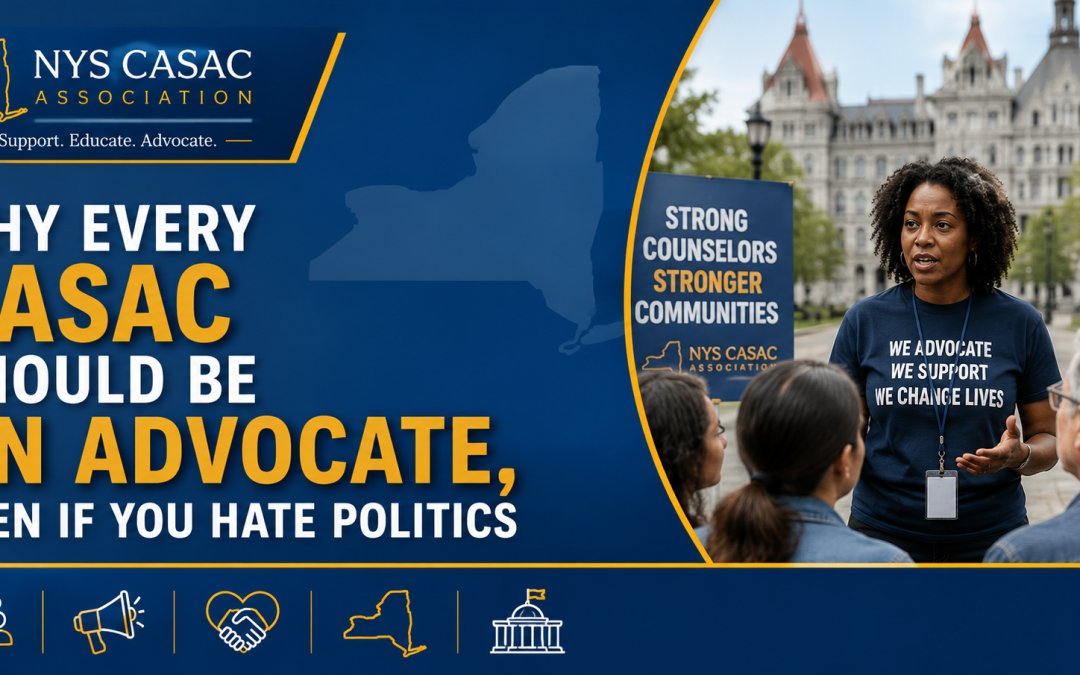
Why Every CASAC Should Be an Advocate (Even If You Hate Politics)
If the word advocacy makes you think about campaign signs, political debates, or partisan arguments, you are not alone. Many addiction counselors avoid advocacy because they believe it belongs in politics rather than in treatment.
Nothing could be further from the truth.
CASAC advocacy is not about supporting one political party over another. It is about protecting clients, strengthening the addiction counseling profession, and ensuring that the people providing care have a voice in the decisions that shape that care.
Every day, New York addiction counselors work under laws, regulations, funding decisions, credentialing standards, and agency policies that were created by someone else. Those decisions influence documentation requirements, staffing levels, supervision, reimbursement, continuing education, and the services available to clients.
If practicing counselors are not part of those conversations, important decisions are made without the perspective of the people who understand addiction treatment best.
Clients lose.
Counselors lose.
Programs lose.
The profession loses.
That is why CASAC advocacy is not optional. It is part of being a healthcare professional.
What advocacy really means
Many people think advocacy only means calling legislators or speaking at the State Capitol.
In reality, advocacy happens in many different ways.
Legislative advocacy includes supporting policies that improve behavioral health services, workforce development, reimbursement, recovery support, and public health.
Regulatory advocacy means participating in public comment opportunities when agencies such as OASAS request feedback on proposed regulations affecting addiction treatment programs, credentialing requirements, or professional practice.
Workplace advocacy means promoting ethical care, appropriate supervision, manageable workloads, and the resources counselors need to provide quality treatment.
Client advocacy happens every day. It involves helping individuals understand their rights, access services, navigate healthcare systems, obtain housing, secure benefits, and overcome barriers that interfere with recovery.
At every level, advocacy is about improving outcomes for clients while strengthening the profession that serves them.
How laws and regulations affect your daily practice
Some counselors assume that policy changes have little impact on their everyday work.
The opposite is true.
New York regulations determine who may provide addiction counseling services, what education is required for credentialing, how supervision is documented, and which ethical standards govern professional conduct.
The OASAS Credentialing Regulations (Part 853) establish professional responsibilities for credentialed addiction professionals, while agency regulations influence documentation, quality assurance, staffing expectations, and program operations.
Funding decisions determine whether treatment providers can expand services, hire additional counselors, improve technology, or offer specialized recovery supports.
Insurance reimbursement affects staffing ratios, appointment availability, and access to care.
Even your daily documentation is influenced by regulatory and payer requirements.
When these decisions are made without meaningful input from practicing addiction counselors, the result can be regulations that increase administrative burden without improving clinical care.
That is why practicing counselors deserve a seat at the table.
Why so many counselors stay silent
Most CASACs believe advocacy matters.
Many simply do not know where to begin.
Some worry they are not knowledgeable enough about legislation.
Others assume policymakers are not interested in hearing from frontline clinicians.
Many feel overwhelmed.
Between documentation, treatment planning, supervision, continuing education, crisis intervention, and personal responsibilities, advocacy can feel like one more task added to an already demanding career.
Another common misconception is believing someone else is already doing the work.
Professional organizations, educators, supervisors, and experienced clinicians all play important roles.
They cannot replace thousands of practicing counselors sharing real experiences from treatment programs across New York.
One thoughtful public comment.
One meeting with a legislator.
One conversation about barriers facing clients.
These actions may seem small individually, but together they shape the future of addiction counseling.
Five ways every CASAC can become an advocate
Advocacy does not require a law degree, political experience, or years of public speaking.
Every addiction counselor can contribute.
1. Participate in public comment opportunities
State agencies frequently request public input before adopting new regulations or changing existing policies.
Submitting thoughtful feedback allows practicing counselors to explain how proposed changes may affect treatment programs, documentation requirements, workforce development, and client care.
Monitoring announcements from OASAS is one of the easiest ways to stay informed about opportunities to contribute.
2. Build relationships with elected officials
Legislators often rely on professionals working in the field to explain how addiction affects communities.
Sharing practical experiences helps policymakers understand the challenges clients and counselors face every day.
Advocacy is most effective when it is respectful, evidence-based, and focused on improving care rather than advancing partisan positions.
3. Join professional organizations
Professional associations give addiction counselors a stronger collective voice.
When thousands of counselors support common goals, policymakers are more likely to recognize workforce concerns, credentialing issues, reimbursement challenges, and barriers affecting treatment access.
Professional organizations also provide education, networking, leadership opportunities, and updates on emerging issues affecting the profession.
4. Educate the public
Substance use disorders continue to be misunderstood by many people. Stigma, misinformation, and outdated beliefs can discourage individuals from seeking treatment and can influence public policy.
CASACs are uniquely qualified to provide accurate, evidence-based information about addiction, recovery, harm reduction, and treatment. Whether speaking at a community event, participating in Recovery Month activities, writing educational articles, or sharing reliable information through professional channels, counselors help replace myths with facts.
Public education is one of the most effective forms of CASAC advocacy because informed communities are more likely to support prevention, treatment, and recovery services.
5. Mentor the next generation
Every experienced counselor remembers someone who answered questions, provided encouragement, or demonstrated what ethical practice looked like.
Mentoring students, CASAC-T professionals, interns, and newly credentialed counselors strengthens the profession long after individual careers have ended.
Sharing knowledge improves clinical competence, increases confidence, and helps preserve professional standards for future generations.
Strong professions invest in those who will eventually lead them.
Every one of these actions strengthens CASAC advocacy while improving the quality of addiction treatment throughout New York.
Professional development strengthens advocacy
Advocacy is not only about influencing legislation or submitting public comments. It is also about continually strengthening the knowledge and skills that make addiction counselors effective advocates for their clients and the profession.
Every new clinical skill, ethics course, and continuing education program helps build a stronger workforce that is prepared to meet the changing needs of New Yorkers affected by substance use disorders.
Whether you are earning your first credential or expanding your expertise through advanced training, investing in professional development is an investment in the future of addiction counseling.
Explore Educational Enhancement CASAC Online’s comprehensive addiction counselor courses to continue building the clinical knowledge, ethical decision-making, and practical skills that strengthen both your career and the profession.
How the NYS Association advocates for members
The NYS Association of CASAC Professionals was created to ensure addiction counselors have a stronger voice in shaping the future of the profession.
The Association encourages members to participate in regulatory comment periods whenever OASAS proposes changes that affect addiction treatment, credentialing, ethics, or workforce development.
It also works with legislators, policymakers, behavioral health organizations, and community stakeholders to promote policies that strengthen addiction counseling and improve access to quality care across New York.
Advocacy extends beyond legislation.
The Association supports workforce initiatives that improve recruitment, retention, leadership development, fair professional recognition, and opportunities for career advancement.
Public education is another important priority. Helping communities understand the value addiction counselors bring to healthcare reduces stigma while increasing confidence in professional addiction treatment.
The Association also encourages members to stay informed about professional standards, ethical responsibilities, and credentialing requirements established by OASAS Credentialing.
Effective CASAC advocacy requires collaboration, consistency, and a commitment to representing both addiction counselors and the people they serve.
Advocacy strengthens the entire profession
Professional recognition is never automatic.
Every respected healthcare profession has earned its place through decades of education, research, leadership, collaboration, and advocacy.
Addiction counseling is no different.
The profession continues to evolve. New treatment approaches emerge. Regulations change. Workforce needs shift. Communities face new challenges related to substance use.
Experienced counselors play an important role in helping shape those changes.
You do not need to become a lobbyist.
You do not need to enjoy politics.
You simply need to recognize that decisions affecting addiction counseling will continue to be made.
The only question is whether practicing addiction counselors will help shape those decisions.
Conclusion
Advocacy is not separate from professional practice.
It is an extension of it.
Every time a counselor supports a client, mentors a colleague, participates in a public comment period, joins a professional association, or pursues additional education, they strengthen the future of addiction counseling.
The NYS Association of CASAC Professionals remains committed to advancing CASAC advocacy, supporting New York’s addiction counseling workforce, and ensuring the voices of practicing CASACs continue to influence the policies and professional standards that shape the future of addiction treatment.
Because protecting clients begins with protecting the profession that serves them.
Join the NYS Association of CASAC Professionals.
Advance your career. Unify with peers. Advocate for the profession. Gain access to training, certification support, and a statewide network that strengthens both you and the CASAC workforce