
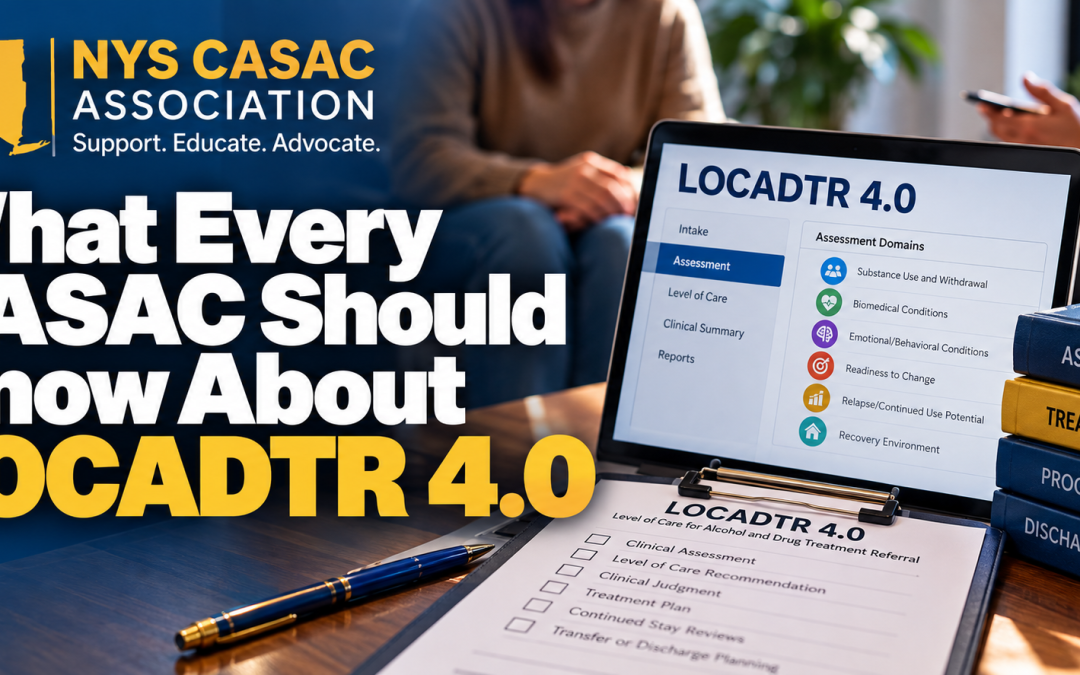
LOCADTR 4.0 Is More Than a Form
Many CASACs see LOCADTR as another task to complete before admission.
That mindset creates problems.
LOCADTR is one of the most important clinical tools used in New York substance use treatment. It helps determine the least restrictive level of care that can safely meet a person’s needs. It also supports continued stay reviews, transfers between programs, and discharge planning. OASAS expects providers to use the state-approved level of care tool together with a comprehensive clinical assessment, not as a replacement for professional judgment.
The software gives you a recommendation.
You make the clinical decision.
Clinical judgment still matters
One of the biggest misconceptions is that the LOCADTR score automatically decides placement.
It does not.
OASAS states that the LOCADTR is designed to support clinical decision-making. If the recommended level of care doesn’t match what your assessment tells you, you can override the recommendation when you clearly document the clinical rationale.
That documentation matters.
A reviewer should be able to understand exactly why you departed from the recommendation.
Admission starts with a complete assessment
LOCADTR works only as well as the assessment behind it.
If important information is missing, the recommendation may not reflect the person’s actual needs.
Your assessment should include:
- Current substance use
- Withdrawal risk
- Physical health
- Mental health
- Recovery environment
- Previous treatment history
- Strengths and protective factors
Every answer affects the final recommendation.
Incomplete assessments produce incomplete clinical decisions.
Common scoring mistakes
Many errors happen before the software calculates a recommendation.
Common problems include:
- Rushing through the assessment
- Guessing instead of asking follow-up questions
- Underestimating withdrawal risk
- Ignoring recovery supports
- Failing to update information after new facts emerge
- Treating the LOCADTR as paperwork instead of a clinical interview
None of these are software problems.
They are assessment problems.
Medical necessity begins here
Medical necessity starts with the level-of-care decision.
If someone is admitted to outpatient treatment, your documentation should explain why outpatient services are appropriate.
If you recommend residential treatment, the assessment should clearly support that recommendation.
The LOCADTR, assessment, treatment plan, and progress notes should tell the same clinical story.
When they do not, utilization reviewers notice.
OASAS guidance links level-of-care decisions directly to documentation that supports medical necessity throughout treatment.
LOCADTR does not end after admission
Some counselors complete the LOCADTR once and never think about it again.
That is a missed opportunity.
OASAS expects the tool to be completed when a change in level of care is being considered. Programs also use the Concurrent Review module during treatment to determine whether the current level of care remains clinically appropriate.
The person’s needs change.
Your level-of-care decision should change with them.
Continued stay reviews
Continued stay reviews answer one question.
Does this person still need this level of care?
Never base the answer on habit.
It should be based on current clinical information.
Reviewers look for documentation showing:
- Progress toward treatment goals
- Remaining barriers
- Current risks
- Response to treatment
- Ongoing medical necessity
A completed Concurrent Review LOCADTR helps support those decisions when it is documented alongside the clinical record.
Transfers require documentation
A transfer is not simply a referral.
It is a clinical decision.
When someone moves from outpatient to residential treatment, or from residential treatment back to outpatient care, the record should explain why the current level of care no longer meets their needs.
OASAS guidance recommends completing a LOCADTR to support these transitions so the receiving provider has clear documentation of the clinical rationale.
That continuity benefits both programs.
More importantly, it benefits the person receiving care.
Discharge begins earlier than most people think
Many counselors think about discharge during the final session.
OASAS takes a different view.
Discharge planning starts at admission.
The goals established early in treatment become the framework for deciding when someone no longer requires that level of care. When discharge is appropriate, the record should explain why and document referrals, continuing care, medications when applicable, and the next recommended level of care.
Good discharge planning is simply good treatment planning carried through to the end.
Document your reasoning
The LOCADTR report alone is not enough.
Your chart should explain your thinking.
A strong record documents:
- The LOCADTR recommendation
- Your clinical judgment
- Any override and why
- How the recommendation informed the treatment plan
- Why the current level of care remains appropriate
That narrative strengthens the entire chart.
Four questions before closing the assessment
Before you finalize a LOCADTR, ask yourself:
- Did I complete a thorough assessment?
- Does the recommendation match my clinical judgment?
- If I overrode the recommendation, did I explain why?
- Will another clinician understand my reasoning six months from now?
If the answer is yes, your documentation is doing its job.
The tool supports your judgment
LOCADTR is not designed to replace clinical experience.
It is designed to organize it.
The strongest clinicians do not complete the assessment just to generate a recommendation. They use the recommendation to test their clinical thinking, strengthen documentation, and support decisions about admission, continued stay, transfer, and discharge.
That is how the tool was intended to be used.
For additional guidance, review the OASAS resources on utilization review, clinical documentation, and level-of-care determinations. You may also find the NYS CASAC Association articles on documentation that survives an OASAS audit, collaborative documentation, and trauma-informed care useful companions to this topic.
Join the NYS Association of CASAC Professionals.
Advance your career. Unify with peers. Advocate for the profession. Gain access to training, certification support, and a statewide network that strengthens both you and the CASAC workforce