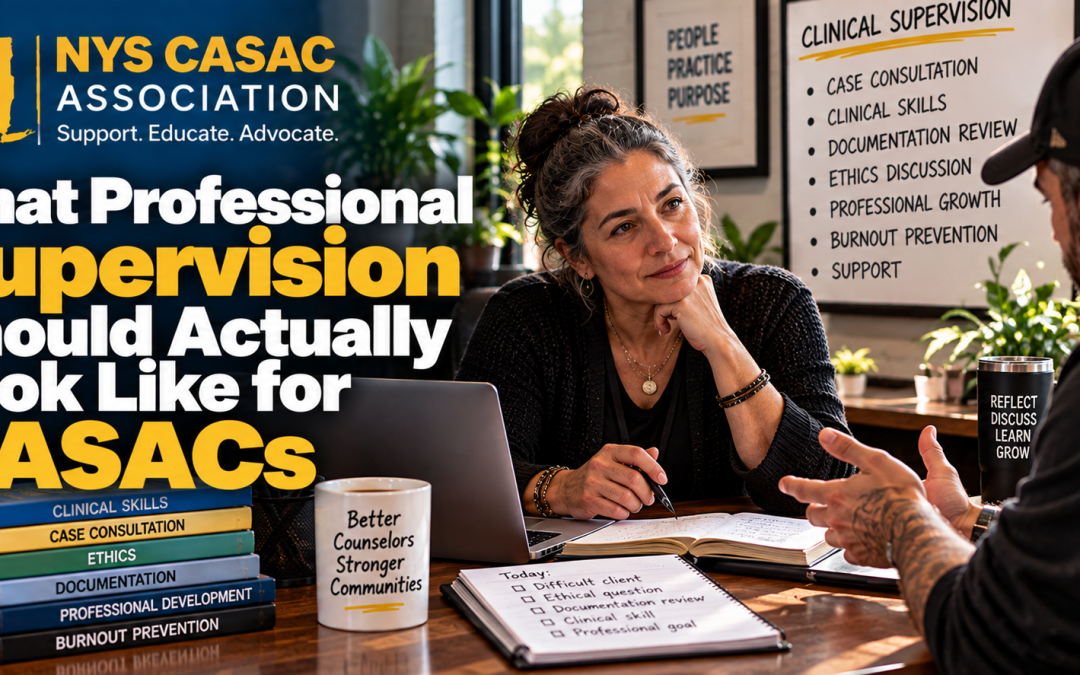
Clinical supervision helps CASACs grow into confident counselors through case consultation, ethical discussion, documentation feedback, and professional support.
What Clinical Supervision Should Actually Look Like for CASACs
You leave clinical supervision with more questions than answers.
The supervisor signed your paperwork.
Reviewed productivity numbers.
Asked if you finished your notes.
Meeting over.
If that sounds familiar, you are not alone.
Many CASACs receive supervision every week. Far fewer receive supervision that actually develops them as clinicians. Those are not the same thing.
A supervisor’s job is not to monitor you.
It is to help you think.
Good supervision changes how you see clients
The best supervisors rarely begin by telling you what you did wrong.
They ask questions.
“What do you think happened in that session?”
“What surprised you?”
“What did you miss?”
“What would you try differently next week?”
Those questions matter.
Good supervision builds clinical judgment, not dependence. You stop looking for the right answer and start learning how to reason through difficult situations.
That lasts an entire career.
Every difficult client belongs in supervision
Some cases stay with you.
You replay conversations driving home. You wonder whether you pushed too hard. You question your treatment plan. You think about what you should have said.
Bring those clients to supervision.
Not your easiest cases.
Your hardest ones.
The client who never speaks.
The client who always argues.
The client who reminds you of someone from your own life.
The client you secretly dread seeing on your schedule.
Those conversations build counselors.
Supervision should be a place where uncertainty is welcome
New counselors often believe they need to appear confident.
Experienced counselors know better.
Some of the strongest supervision begins with one sentence.
“I don’t know what to do.”
That is not weakness.
That is clinical honesty.
The counselor who asks for help before making an ethical mistake is practicing good judgment.
The counselor who never asks questions usually worries me more.
Feedback should be specific
“Nice session.”
That feels good.
It teaches nothing.
Specific feedback changes practice.
“You asked three questions in a row without giving the client space to think.”
“You answered for the client twice.”
“You shifted topics just as the emotion became important.”
Now you have something to work on.
Great supervisors observe behavior.
They do not judge character.
Documentation deserves conversation
Documentation review should never feel like proofreading.
The note is only part of the discussion.
Why did you choose that intervention?
Why did you focus on that goal?
Why did you summarize the client’s statement that way?
The documentation becomes a window into your clinical thinking.
That is where growth happens.
Ethics rarely arrive with obvious answers
No counselor wakes up planning to cross a boundary.
Most ethical problems begin quietly.
A friend request.
A client you recognize from a recovery meeting.
A family member asking for information.
A gift that feels awkward to refuse.
A former client who wants to meet for coffee.
None of these situations fit neatly into a checklist.
They belong in supervision before they become problems.
The best supervisors create room for those conversations without judgment.
Burnout is easier to prevent than repair
Burnout usually arrives without announcing itself.
You become impatient.
You stop looking forward to sessions.
Your curiosity fades.
You begin counting hours instead of conversations.
The paperwork feels heavier every week.
You tell yourself you are simply tired.
Good supervisors notice those shifts.
Sometimes the most valuable part of supervision has nothing to do with a client’s chart.
It starts with a different question.
“How are you holding up?”
That question has kept more counselors in this profession than any productivity report ever will.
Administrative supervision is not clinical supervision
Both matter.
They are not interchangeable.
Administrative supervision keeps programs running.
Schedules.
Policies.
Compliance.
Caseloads.
Performance expectations.
Clinical supervision develops counselors.
It explores decisions.
Challenges assumptions.
Builds confidence.
Strengthens ethics.
Expands clinical skill.
When every supervision meeting becomes an administrative meeting, something important disappears.
The counselor stops growing.
New counselors need coaching, not perfection
No one expects a newly licensed nurse to know everything.
No one expects a rookie firefighter to lead every emergency.
Behavioral health sometimes expects new counselors to carry complex caseloads after only a short orientation.
That expectation drives people away.
The first year should be filled with observation.
Questions.
Case consultation.
Feedback.
Practice.
Reps.
Strong supervision challenges new counselors without leaving them feeling alone.
That balance matters.
The best supervisors never stop being supervisors
Think about the people who shaped your career.
You probably remember very little about their paperwork.
You remember the conversations.
The question they asked that changed how you viewed a client.
The moment they challenged one of your assumptions.
The day they trusted your judgment.
The time they reminded you that making mistakes is part of becoming competent.
That is supervision.
Not checking a box.
Building a professional.
The strongest counselors I know still seek supervision. They still ask difficult questions. They still invite honest feedback. Experience does not remove the need for reflection. If anything, it makes reflection more valuable.
A profession becomes stronger one counselor at a time. Good supervision is where that work begins.
Join the NYS Association of CASAC Professionals.
Advance your career. Unify with peers. Advocate for the profession. Gain access to training, certification support, and a statewide network that strengthens both you and the CASAC workforce