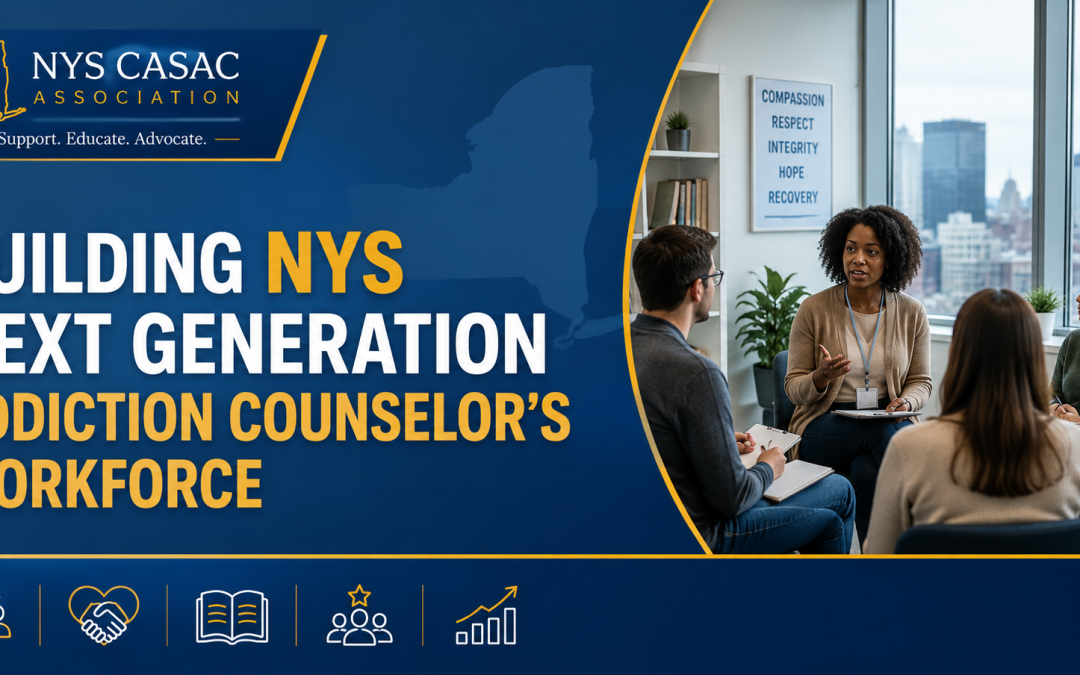
Building New York’s addiction counselor workforce through mentorship, retention, and professional advocacy
Every experienced professional in the addiction counselor workforce remembers the first counseling session that truly tested their confidence.
A client walked out.
A family member demanded information that could not legally be shared.
A person arrived in withdrawal and needed more support than one counselor could provide.
Classroom education helped prepare us for those moments. It gave us the language, ethical standards, and clinical foundation needed to begin the work.
Still, most counselors learned how to manage difficult situations because an experienced supervisor or colleague took the time to guide them.
That is how a profession survives.
The future of New York’s addiction counselor workforce will depend on more than attracting people into training. We must also prepare them for real clinical work, support them during the difficult early years, and give them reasons to remain in the profession.
Recruitment opens the door.
Education, supervision, and professional respect keep people from walking back out.
The demand for qualified counselors continues to grow
The need for behavioral health professionals is not expected to slow down.
The U.S. Bureau of Labor Statistics projects 17 percent employment growth for substance use, behavioral disorder, and mental health counselors between 2024 and 2034. It also projects about 48,300 openings each year across the country. Many will result from growth, retirement, and workers leaving for other occupations.
Those numbers represent more than vacant positions.
They represent people waiting for assessments.
People trying to enter treatment.
Families looking for answers.
Programs struggling to maintain manageable caseloads.
Communities cannot respond effectively to substance use disorders without a stable addiction counselor workforce. Treatment access means little when programs cannot recruit or retain the professionals needed to provide that treatment.
Recruitment alone will not solve the problem
Workforce discussions often begin with the same question.
How do we convince more people to enter the field?
That question matters. It is not enough.
We must also ask why trained counselors leave.
Many new professionals enter addiction counseling because they want to help people. Then they encounter high caseloads, low compensation, documentation pressure, limited advancement opportunities, and inconsistent clinical supervision.
Commitment does not erase exhaustion.
Passion does not pay rent.
A counselor may care deeply about the work and still decide that the working conditions are unsustainable.
Building the addiction counselor workforce requires honest attention to retention. Agencies must examine what happens after recruitment. A new employee should not receive a brief orientation, a full caseload, and instructions to ask questions when needed.
That is not workforce development.
That is abandonment with paperwork.
New counselors need strong clinical supervision
Education teaches counselors what ethical and effective practice should look like.
Supervision helps them apply that knowledge when situations become complicated.
The SAMHSA clinical supervision guidance describes supervision as a central part of developing counselor competence. It addresses supervisory models, ethics, cultural responsiveness, performance monitoring, and professional growth.
Good supervision does not exist only to approve documentation.
It creates a protected space where counselors can examine their decisions.
Why did the client disengage?
Was the counselor moving faster than the client?
Did personal frustration affect the session?
Was a boundary crossed?
Could the intervention have been handled differently?
These conversations develop judgment. They also reduce isolation.
New counselors need permission to say, “I do not know what to do next,” without being humiliated. They need supervisors who can correct mistakes directly while still treating them as developing professionals.
The strength of the addiction counselor workforce depends heavily on the quality of that supervision.
CASAC-T and CASAC-P professionals need structured support
New York has established several entry points into the credentialing process.
The OASAS CASAC application guidance explains the education and documentation requirements for CASAC applicants, including the CASAC-Trainee and CASAC-Provisional pathways. Applicants pursuing exam eligibility must complete the required 350 hours of education and the designated one-time training requirements.
Those credentials create opportunities to begin working in the field.
They do not mean the person has finished learning.
A CASAC-T or CASAC-P professional may understand counseling theories and still struggle with confrontation, silence, resistance, relapse, documentation, or family dynamics.
That is normal.
Competence develops through practice, reflection, correction, and repetition.
Agencies supporting newer counselors should provide:
- Weekly clinical supervision
- Gradual caseload development
- Clear documentation examples
- Case consultation opportunities
- Direct feedback without humiliation
- Access to continuing education
- Transparent advancement pathways
OASAS supervision guidance calls for at least weekly clinical supervision for CASAC-Trainees. That requirement should be treated as meaningful clinical development, not another box to check.
Experienced counselors are responsible for passing knowledge forward
Every experienced counselor knows something that cannot be taught fully through a slide presentation.
How do you challenge a client without creating a power struggle?
How do you recognize when your personal history is affecting the session?
How do you respond when a client asks a question that tests professional boundaries?
How do you document a complicated encounter clearly and objectively?
These skills are built in practice.
I entered this profession with lived experience of homelessness, substance use disorder, treatment, relapse, and recovery.
That experience helped me understand pain.
It did not automatically teach me how to counsel another person.
Supervisors, educators, and experienced clinicians helped me develop those skills. They corrected me when I needed correction. They answered questions. They helped me separate my personal experiences from the needs of the person sitting in front of me.
Someone invested time in my development.
Experienced professionals now have an obligation to make that same investment in the next generation.
Mentorship does not require a formal program.
It can begin with one counselor answering one question honestly.
Education must remain connected to real practice
A strong education program should do more than prepare students to pass an exam.
Students must learn how ethical standards, counseling theories, assessment practices, treatment planning, documentation, and trauma-informed care connect inside an actual treatment setting.
They also need realistic expectations.
This profession can be rewarding.
It can also be exhausting, frustrating, and emotionally demanding.
Students should hear both truths.
People preparing for credentialing or continuing education can strengthen their clinical foundation through addiction counselor courses designed for working professionals. Education should help counselors think more clearly, make better decisions, and respond more effectively when the work becomes difficult.
Professional development is not about collecting certificates.
It is about becoming safer and more competent.
Agencies must create reasons for counselors to stay
Retention is shaped by workplace conditions.
Counselors are more likely to remain when they receive competent supervision, manageable expectations, professional respect, and opportunities to advance.
They are more likely to leave when every week feels like an emergency.
Agencies serious about strengthening the addiction counselor workforce should examine:
- Compensation
- Caseload size
- Documentation expectations
- Supervisor availability
- Training access
- Promotion opportunities
- Staff safety
- Recognition of credentials
Free pizza does not repair chronic understaffing.
A wellness email does not replace protected supervision.
Calling employees heroes does not excuse poor working conditions.
Organizations must demonstrate respect through policy, staffing, compensation, and leadership behavior.
Continuing education strengthens the whole treatment system
Credentialing is not the end of professional development.
Counselors must remain current as regulations, ethical concerns, technology, treatment approaches, and community needs change.
The OASAS professional training system provides live and self-paced education for New York’s addiction workforce. Available training includes credentialing coursework, renewal education, and professional development across treatment, prevention, recovery, and harm reduction services.
Continuing education should not be treated as a last-minute renewal requirement.
It should help counselors respond to weaknesses in their practice.
A counselor struggling with documentation needs documentation training.
A supervisor struggling to provide feedback needs supervision training.
A clinician working with trauma survivors needs more than a basic definition of trauma-informed care.
Professional growth should address the work counselors are actually doing.
Advocacy is part of workforce development
The addiction counselor workforce cannot be strengthened through education alone.
Professional advocacy matters.
Counselors need credential recognition, fair compensation, strong supervision standards, reasonable workloads, and a voice in the policies affecting their practice.
The profession also needs clear career pathways.
New counselors should be able to see how experience, education, and advanced credentials can lead to supervision, program leadership, training, policy work, and other professional roles.
Without advancement, people leave.
Without professional recognition, recruitment becomes harder.
Without organized advocacy, decisions affecting counselors will continue to be made without enough counselor input.
Building the future begins with one professional
Reports can identify workforce shortages.
Committees can discuss retention.
Agencies can write strategic plans.
None of that replaces direct action.
An experienced counselor can mentor a CASAC-T.
A supervisor can protect meaningful supervision time.
An agency leader can review unrealistic caseload expectations.
An educator can prepare students for the realities of clinical practice.
A professional association can advocate for recognition and fair treatment.
Each action matters.
Choose one developing counselor.
Review one difficult case.
Answer one question.
Share one lesson you had to learn the hard way.
The future of New York’s addiction counselor workforce will be built through those daily investments.
Someone helped prepare us for this work.
Now it is our responsibility to prepare whoever comes next.
Counselors looking to strengthen their assessment, ethics, documentation, or counseling skills can continue their education through Educational Enhancement CASAC Online’s addiction counselor courses, which are designed for both new and experienced professionals.
Join the NYS Association of CASAC Professionals.
Advance your career. Unify with peers. Advocate for the profession. Gain access to training, certification support, and a statewide network that strengthens both you and the CASAC workforce