
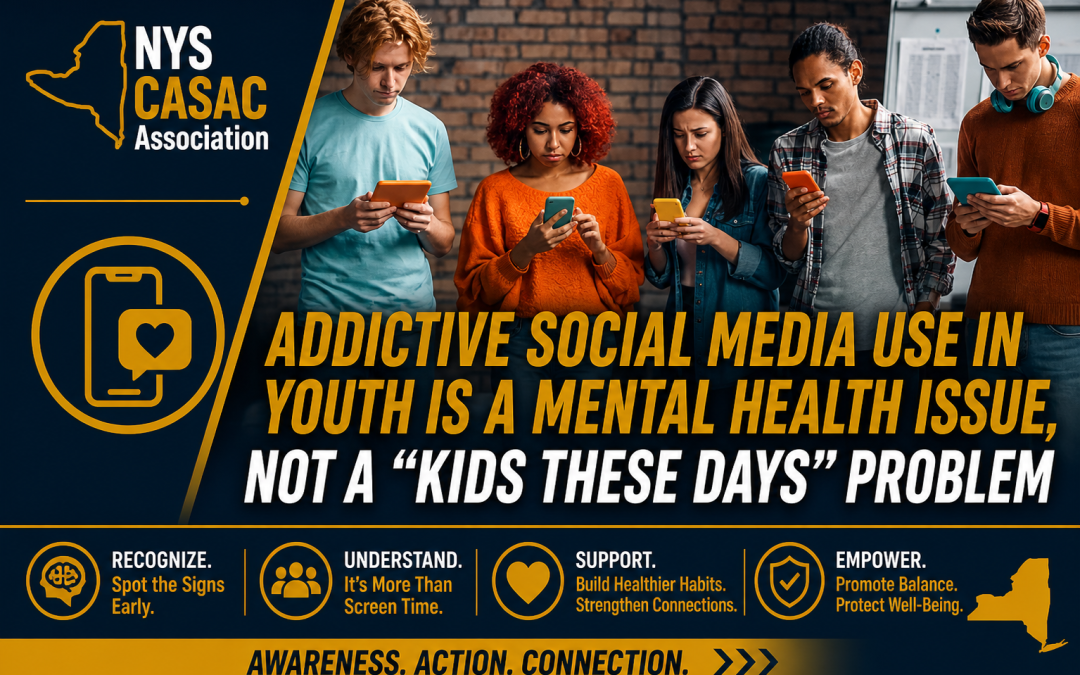
You see it in waiting rooms and school hallways.
A kid stares at a phone like it is oxygen.
A teen snaps when the battery hits 5 percent.
A parent says, “They are on it all day,” then looks defeated.
You are not imagining it.
The research has caught up to what you and I already see.
Columbia and Weill Cornell researchers found that addictive use patterns of social media, video games, and mobile phones were linked to worse mental health and suicide related outcomes in youth. Total time on screens did not show the same link.
Do you need to panic and throw every phone in the ocean? No. You need to focus on addictive use patterns, not just minutes on a clock.
What “addictive use” means in real life
Columbia describes addictive use as excessive use that interferes with schoolwork, home responsibilities, or other activities.
That definition matters. It matches what families describe.
It is not only “they use it a lot.”
It is “they cannot stop even when it causes problems.”
Here are common patterns that fit addictive use:
-
Loss of control, they try to cut back and fail
-
More time needed to feel satisfied
-
Used to escape stress or sadness
-
Withdrawal style reactions, irritability, and distress when access ends
-
Neglect of homework, chores, sleep, or in-person relationships
When you work in behavioral health, this list should sound familiar.
It is the same loop you see with other compulsive behaviors. The target changes. The brain rules stay similar.
What the data says about risk
Columbia’s write-up shares two points that should shape how you talk to families and teens.
For social media, about 40 percent of children had high or increasing addictive use patterns.
For social media and mobile phones, kids with high or increasing addictive use had a two to three times greater risk of suicidal behaviors and suicidal ideation than kids with low addictive use patterns.
Read that again.
This is not only “they are distracted.”
This can be a suicide risk.
Now add what we see in broader studies.
A 2023 study in PMC reported that 48% of adolescents used social media for 3 hours or more per day. It also found heavy use at three hours or more was linked to higher odds of severe psychological distress, with an adjusted odds ratio of around 2.01.
Time alone is not the whole story.
Time can still matter when it signals a bigger pattern.
So you track both:
-
Time as a red flag
-
Addictive use behaviors are the main clinical target
Join the NYS Association of CASAC Professionals.
Advance your career. Unify with peers. Advocate for the profession. Gain access to training, certification support, and a statewide network that strengthens both you and the CASAC workforce
What it does to sleep, mood, and daily function
If you want one area to start with, start with sleep.
John Hopkins notes that scrolling can lead to stress and sleep disruption, and people often plan “a few minutes” and end up staying on for over an hour.
It also points to social isolation, reduced outdoor activity, and fewer healthy routines associated with heavy use patterns.
Pew adds another layer from teen reports.
In a 2025 Pew survey, 45 percent of teens said social media hurts their sleep, and 40 percent said it hurts productivity.
Pew also found gender differences. Girls were more likely than boys to say social media hurt their mental health, sleep, and confidence.
This gives you clear, practical talking points in session.
Not vague “phones are bad” talk.
Specific targets:
-
Sleep quality
-
Mood symptoms
-
School performance
-
Isolation and conflict at home
The reward system angle that families understand
People ask, “Why can’t they just stop?”
Here is the simple answer.
These platforms feed the reward system.
Likes, comments, streaks, and endless scrolling create quick hits.
Quick hits train repetition.
When I was in active substance use disorder, my brain chased relief the same way.
Not the same substance. Not the same outcome.
The same loop.
I remember waking up sick, thinking I would stop, then moving through the day like my body had its own plan. That is what compulsive behavior feels like. It is not a cute habit. It is a tug-of-war inside your own head.
That is why you do not shame teens for “being lazy.”
You teach skills that interrupt the loop.
What you watch for in teens
You can spot addictive use patterns without turning into the phone police.
Look for behavior shifts.
-
Irritability when access ends
-
Sleep decline, late-night scrolling, late mornings
-
Drop in grades or missed assignments
-
Pulling away from friends in person
-
Loss of interest in sports, music, or hobbies
-
Constant checking, even during meals or conversations
-
Anxiety spikes tied to notifications
Then ask direct questions.
-
What happens when you try to stop
-
What do you lose when you stay on
-
What do you feel right before you pick up the phone
Keep it respectful. Keep it real.
Teens can smell fake concern from across the room.
What do you do that actually helps
You need steps that families can repeat.
Start small and stay consistent.
Set phone-free zones
John Hopkins recommends phone-free hours and spaces, and turning off notifications.
Pick two zones to start:
-
Bedroom at night
-
Dinner table
You can add more later.
Build a sleep-first plan
If sleep improves, everything gets easier.
-
Devices out of the bedroom
-
A set stop time for scrolling
-
A simple wind-down routine
Teach urge skills
You are not treating “phone use.”
You are treating urges.
Try:
-
Ten slow breaths before opening an app
-
Put the phone down for two minutes, then decide
-
One replacement action ready to go: walk, shower, snack, stretch
-
A daily check-in, “Did this help me today or drain me?”
Bring parents into modeling
Johns Hopkins points out that kids copy what they see.
So the family plan includes the adults.
No lectures from a parent who scrolls all night.
That never works.
How you frame it for teens without turning them off
Teens do not respond to fear speeches.
They respond to honesty and control.
So you offer a deal.
You are not taking their phone.
You are helping them feel better.
You show the why:
-
Better sleep
-
Less anxiety
-
More focus
-
Less drama
-
More control over their own mood
Then you measure progress.
Pick one metric:
-
Hours of sleep
-
Number of late-night scroll sessions
-
Mood rating from 0 to 10
-
Homework completion
-
Time spent outdoors
Concrete measures beat arguments.
What you want to remember as a counselor, parent, or educator
This crisis is not solved by counting minutes.
Columbia’s work points to addictive use patterns as the stronger signal for mental health outcomes, not total screen time.
Pew shows many teens see sleep and productivity harms, and girls report more negative impacts in key areas.
Johns Hopkins lays out the day-to-day pathways, sleep disruption, isolation, and loss of healthy activities.
Your job is to act early.
Name the pattern.
Support the family.
Teach skills.
Track progress.
No shame. No moral labels.
Just honest care that helps kids get their minds back.
Stay Connected With NYS-CASAC Association NEWS
Don’t miss the updates, spotlights, and resources shaping addiction counseling in New York. Join the NYS Association of CASAC Professionals today for full access to announcements, newsletters, and advocacy news that strengthen your voice and career.