What Every CASAC Should Know About OASAS Documentation Requirements
Every CASAC has heard someone say, “Document everything.”
That advice is incomplete.
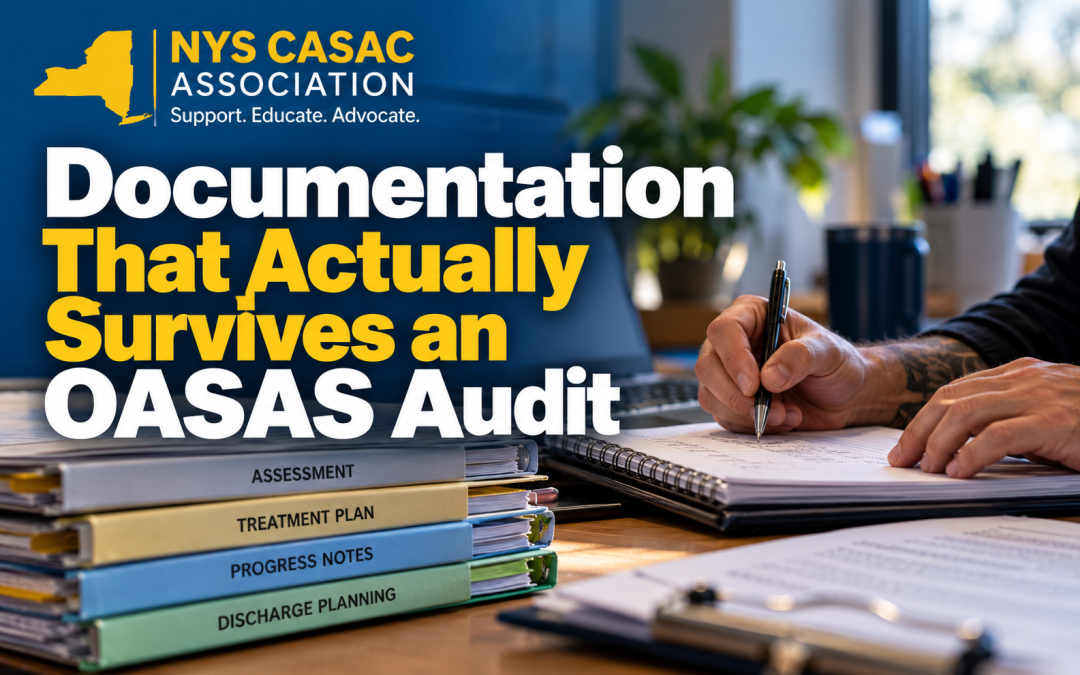
An OASAS audit is not looking for the longest chart. It is looking for a chart that tells a clear clinical story. Every assessment, treatment plan, progress note, and review should connect. When one piece does not support the next, reviewers notice.
That is where many charts fail.
The goal is not more documentation.
The goal is better documentation.
Documentation begins with medical necessity
Medical necessity is one of the first things an auditor evaluates. Your documentation should explain why the person needs the current level of care and why the services provided are clinically appropriate. OASAS guidance emphasizes that providers must document the clinical basis for admission, continued treatment, and discharge planning as part of ongoing utilization review. Addiction Services Office
A strong note answers simple questions.
- Why was today’s session necessary?
- What clinical issue was addressed?
- What intervention was provided?
- How did the person respond?
- What happens next?
If those questions remain unanswered, your documentation is incomplete.
Your chart should tell one story
Many documentation problems begin when records stop connecting.
The assessment identifies needs.
The treatment plan turns those needs into measurable goals.
Progress notes describe the work completed toward those goals.
Treatment plan reviews explain progress, barriers, or revisions.
Discharge planning shows why the current level of care is no longer appropriate.
Every document should support the next one.
A reviewer should never wonder why an intervention appeared in a progress note if it was never identified in the assessment or treatment plan.
That disconnect creates unnecessary questions.
Common documentation deficiencies
The same issues keep appearing in internal quality reviews.
- Treatment plans that never change
- Generic progress notes
- Missing response to intervention
- No evidence of medical necessity
- Goals unrelated to assessed needs
- Identical notes copied across multiple sessions
- Missing rationale for continued treatment
None of these problems require better writing.
They require better clinical thinking.
Avoid copy-and-paste documentation
Electronic health records make copying yesterday’s note easy.
That convenience creates risk.
If every note looks the same, reviewers cannot determine what actually occurred during each session. Identical notes also weaken the record when demonstrating progress or continued need for treatment.
Each encounter should reflect that day’s clinical work.
The person’s presentation changes.
Their stressors change.
Their motivation changes.
Your documentation should change with them.
Short notes are acceptable.
Repeated notes are not.
A weak note
Consider this example.
“Client attended session. Discussed recovery. Participated well. Continue treatment.”
Nothing in that note demonstrates clinical decision-making.
A reviewer cannot identify the intervention, the response, or why treatment should continue.
A stronger note
Now compare it with this version.
“The person reported increased cravings after losing employment this week. Reviewed high-risk situations and developed a written coping plan using motivational interviewing techniques. The person identified three supports they agreed to contact before the next appointment. Continued outpatient treatment remains appropriate due to increased relapse risk.”
Same session.
Different quality.
The second note documents the clinical issue, intervention, response, and rationale for continued care.
That is what reviewers expect.
Treatment plans should evolve
Treatment plans are living documents.
They should reflect progress.
They should reflect setbacks.
They should reflect changing priorities.
One of the easiest ways to weaken a chart is to leave the original treatment plan untouched for months while progress notes describe completely different work.
If the focus changes, update the plan.
If goals are achieved, close them.
If new barriers appear, document them.
The treatment plan should always match current care.
Utilization review starts before the auditor arrives
Many counselors think utilization review begins when someone requests records.
It starts much earlier.
OASAS requires certified providers to maintain an internal utilization review process that evaluates whether admissions remain appropriate, services are clinically necessary, and the current level of care continues to meet the person’s needs. Addiction Services Office
Good documentation makes that review straightforward.
Weak documentation creates delays, questions, and corrective action.
Documentation should describe behavior, not labels
Person-first language belongs in every chart.
Write what you observed.
Document what the person reported.
Describe measurable behavior.
Avoid assumptions.
Instead of writing, “The client was manipulative,” document the behavior that led to your clinical impression.
Instead of writing, “The client lacks motivation,” describe missed appointments, incomplete homework, or stated ambivalence toward change.
Observable facts strengthen documentation.
Labels weaken it.
Four questions before you sign the note
Before closing the chart, ask yourself four questions.
- Does this note match the treatment plan?
- Does it explain why today’s service was necessary?
- Does it describe the person’s response?
- Could another counselor continue treatment using only this documentation?
If the answer is yes, your documentation is probably doing its job.
Documentation protects your clinical work
Many CASACs think documentation exists for auditors.
It does not.
Documentation protects continuity of care.
It supports communication across treatment teams.
It demonstrates medical necessity.
It provides evidence of the clinical decisions you make every day.
An audit does not create documentation problems.
It reveals them.
Strong documentation is not about writing more.
It is about making your clinical reasoning visible.
That is what survives an OASAS audit.
For more guidance, review the latest OASAS implementation and utilization review guidance. You may also find the NYS CASAC Association resources on collaborative documentation, trauma-informed care, and person-first language useful for strengthening everyday documentation practices.
Join the NYS Association of CASAC Professionals.
Advance your career. Unify with peers. Advocate for the profession. Gain access to training, certification support, and a statewide network that strengthens both you and the CASAC workforce