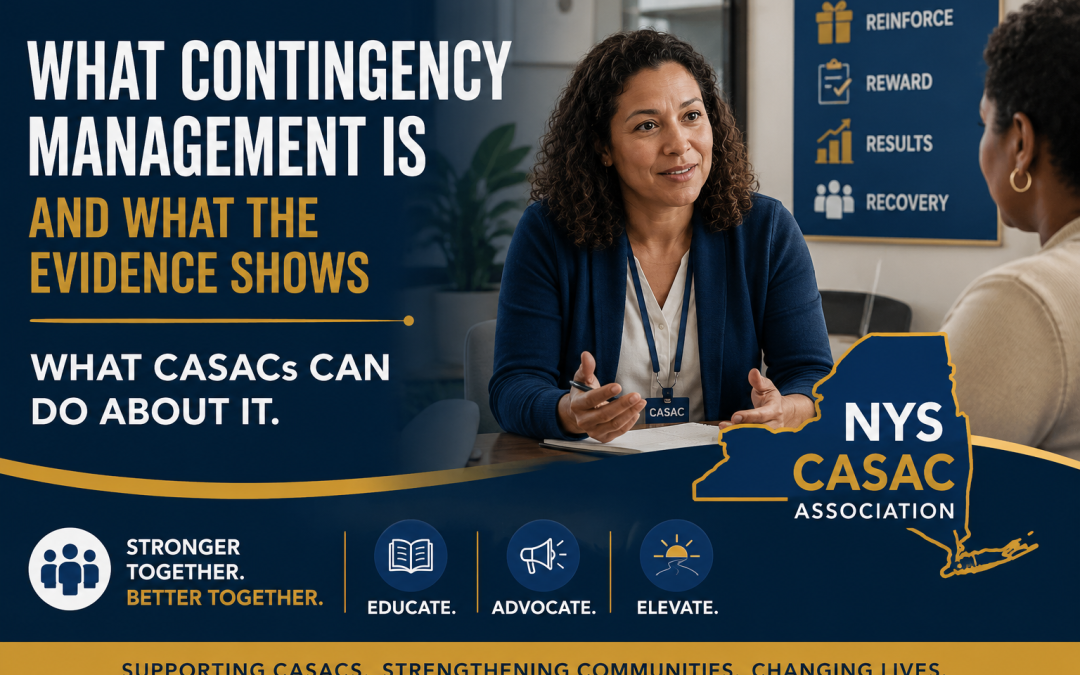
Contingency management for stimulant use disorder gives CASACs a structured way to reinforce measurable change when no approved medication exists.
Contingency Management for Stimulant Use Disorder: What New York CASACs Need to Know
A client returns for another session.
They want to stop using cocaine. They understand the risks. They have a treatment plan, relapse prevention worksheet, and three phone numbers.
Their toxicology result remains positive.
The counselor repeats the same discussion.
Motivation. Triggers. Consequences. Goals.
Fine. Then what?
Contingency management for stimulant use disorder gives treatment programs another clinical tool. It uses structured incentives to reinforce defined behaviors, such as attending treatment or providing stimulant-negative toxicology results. SAMHSA describes it as a proven intervention for substance use disorders, supported by decades of research.
This is not paying people to recover.
It is behavioral treatment.
The mechanism is simple
Contingency management starts with one clear behavior.
The program identifies the behavior, verifies it, and provides a prompt reward. The reward grows through repeated success. A missed target resets or reduces the incentive under the program’s written rules.
The sequence looks like this:
- Define the target
- Measure it consistently
- Reinforce it quickly
- Repeat the process
The incentive can take several forms. Programs have used vouchers, gift cards, prize draws, and access to practical goods.
The reward matters.
The timing matters more.
A delayed reward has less behavioral force. The client needs a clear connection between the completed behavior and the incentive received.
That connection builds reps.
The evidence is stronger than the adoption
OASAS identifies contingency management and cognitive behavioral therapy as the two treatments with the best support for cocaine and methamphetamine use disorders.
No medication has received FDA approval for stimulant use disorder.
That leaves a major treatment gap.
Counselors can use motivational interviewing, cognitive behavioral therapy, community reinforcement, harm reduction planning, and treatment for coexisting conditions. Those interventions matter.
Still, SAMHSA’s treatment guidance for stimulant use disorders identifies contingency management as one of the strongest available behavioral options.
Knowledge and access remain far apart.
Programs have faced funding restrictions, concerns about federal anti-kickback rules, staff training needs, toxicology costs, and discomfort with giving incentives for behavior people think clients should perform without rewards.
That last objection carries a moral presupposition.
Clinical treatment should not depend on whether a behavior looks virtuous.
Stimulants now sit inside the fentanyl crisis
The old clinical map separated stimulant use from opioid risk.
That map no longer works.
A CDC review of stimulant-involved drug poisoning deaths found that 59 percent of deaths from January 2021 through June 2024 involved a stimulant. About 43 percent involved both stimulants and opioids.
CDC reported that nearly 60,000 deaths in 2023 involved cocaine, psychostimulants, or both. That represented about 57 percent of all drug poisoning deaths that year.
A client who reports cocaine use may face fentanyl exposure.
A client using methamphetamine may combine it with opioids intentionally.
Another person may use stimulants to stay awake after opioid use.
The categories overlap.
So the clinical response must include naloxone, drug checking education, cardiovascular risk assessment, and direct questions about polysubstance use.
Contingency management does not replace harm reduction.
It sits beside it.
New York recognizes the intervention
OASAS outpatient clinical standards have listed contingency management among the practices programs can adopt. The standards place it beside cognitive behavioral therapy, motivational interviewing, trauma-informed care, and other accepted treatment methods.
New York has not yet established broad Medicaid coverage for contingency management across the state.
That claim needs to stay clean.
The New York State Medicaid Evidence-Based Benefit Review Advisory Committee reviewed contingency management for stimulant use disorder in April 2025. Later meeting records stated that discussions with OASAS were still underway in November 2025.
So New York is studying coverage.
It has not announced statewide Medicaid payment.
Federal Medicaid programs in several states have received Section 1115 authority to test contingency management. Those approvals show one route New York can examine, but they do not create automatic coverage here.
The CASAC role stays clinical
A CM program needs more than gift cards and toxicology cups.
CASACs help explain the treatment. They review the target behavior. They address shame after a missed target. They watch for manipulation, inconsistent testing, or rules applied differently across clients.
They also keep the incentive from replacing counseling.
A CASAC working inside a CM program may:
- Review consent and program rules
- Collect or coordinate toxicology testing
- Record verified target behaviors
- Deliver incentives under written procedures
- Process setbacks without punishment
- Connect progress to the treatment plan
The counselor should not change rewards informally.
Do not improvise. Do not make side deals. Do not withhold an earned incentive to teach a lesson.
Consistency protects the treatment.
Documentation must show the clinical purpose
A note should identify the target behavior, how staff verified it, the incentive provided, and how the activity connects to the treatment plan.
Keep the language factual.
Documentation must show the clinical purpose.
“Client provided a stimulant negative toxicology sample and received the scheduled incentive under program protocol. Counselor reviewed coping strategies used since the prior visit.”
A positive result should not trigger moral language.
“Result indicated cocaine use. No incentive was issued under program rules. Counselor reviewed recent use, fentanyl exposure risk, naloxone access, and the next testing date.”
That note records treatment.
It does not weaponize the result.
Incentives need guardrails
Programs need written rules covering eligibility, target behaviors, reward schedules, maximum values, verification, lost cards, suspected fraud, staff roles, and recordkeeping.
Staff need training before launch.
Clients need the same explanation.
Supervisors need a process for reviewing exceptions.
Pause. Check the rule. Document the decision.
The federal policy discussion has focused heavily on guardrails, program oversight, and protection against fraud. That scrutiny should not become an excuse for permanent delay. It should produce a cleaner program.
What New York counselors should watch
Watch the state Medicaid review.
Watch for OASAS guidance, billing instructions, pilot announcements, and staff training.
Ask your program whether it already uses contingency management through grant funds or another approved source. OASAS has previously permitted CM inside grant-funded work when the intervention fit the grant and followed funding limits.
Counselors who need a broader clinical base can review substance use counselor courses for working professionals alongside the NYS CASAC Association’s practice resources.
Start with the behavior
Contingency management for stimulant use disorder does not replace relationships, judgment, or harm reduction.
It adds structure.
Pick a measurable behavior. Reinforce it quickly. Apply the rules evenly. Review what worked.
The field has spent years asking clients to change through consequences.
It is time to get better at reinforcing progress.
Join the NYS Association of CASAC Professionals.
Advance your career. Unify with peers. Advocate for the profession. Gain access to training, certification support, and a statewide network that strengthens both you and the CASAC workforce