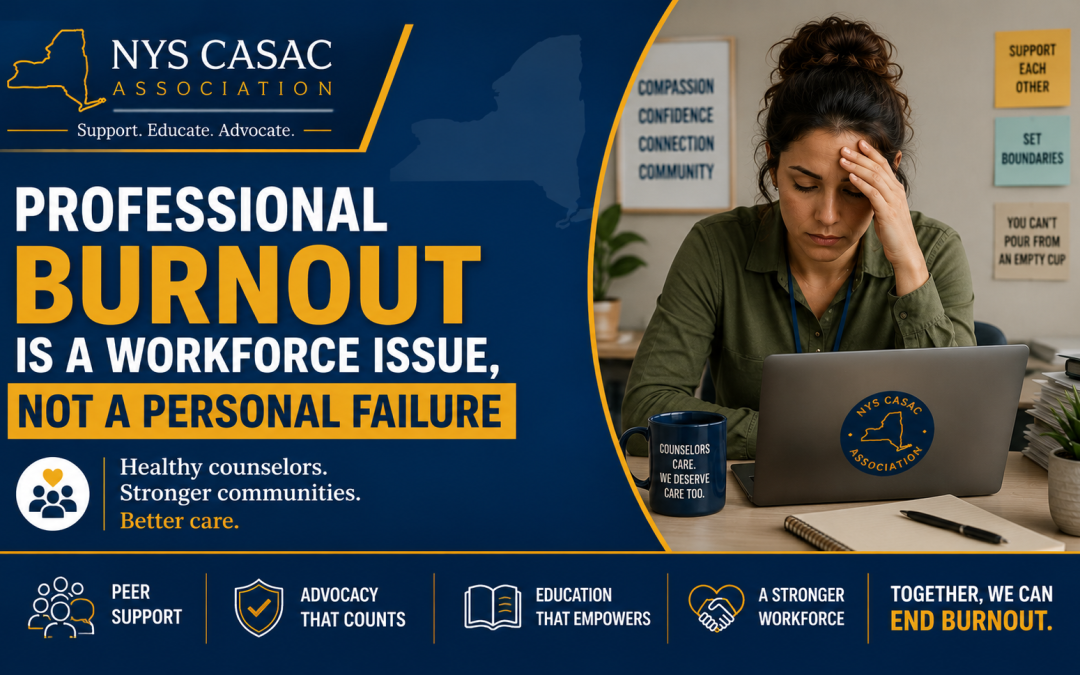
Counselor burnout harms staff retention, clinical judgment, and client care. Reducing it requires organizational change, firm boundaries,
and professional support.
Professional Burnout Is a Workforce Issue, Not a Personal Failure
You close your last session and open six unfinished notes.
A voicemail needs an answer. Tomorrow’s caseload is already full. Your supervisor needs productivity numbers before you leave.
You feel tired, detached, and irritated.
Then someone sends a wellness email.
Fine. Then what?
Counselor burnout is not proof that you stopped caring. It often shows that the work has exceeded the support available to complete it.
That is a workforce problem.
Burnout has a recognizable pattern
Burnout is more than feeling tired after a difficult week.
The World Health Organization describes burnout through three work-related features: exhaustion, growing distance or cynicism toward the job, and reduced professional effectiveness. It classifies burnout as an occupational phenomenon, not a medical condition.
The signs often arrive in pieces.
Fatigue that sleep does not fix. Irritation with clients you normally like. Notes that take twice as long. A growing need to avoid coworkers. Dread before opening your schedule.
That pattern deserves attention.
Counselor burnout can affect memory, patience, documentation, boundaries, and clinical judgment. Clients notice rushed sessions. Coworkers absorb unfinished work. Agencies lose trained staff.
The damage spreads.
Compassion fatigue changes how the work feels
Substance use counselors hear painful histories every day.
Violence. Grief. Family separation. Homelessness. Childhood trauma. Accidental drug poisoning. Repeated loss.
Exposure to suffering carries a load.
Compassion fatigue can include emotional depletion and secondary traumatic stress. SAMHSA’s Professional Quality of Life Scale measures burnout, compassion satisfaction, and secondary traumatic stress as related but separate experiences.
A counselor can remain competent and still feel emotionally raw.
The response should not be shame.
The response should be assessment, supervision, and workload change.
Documentation overload is still workload
Documentation protects clients and records clinical decisions.
It can still become weaponized.
Repeated forms, duplicate entry, late policy changes, and unrealistic deadlines create hours of hidden labor. Agencies often count the session but ignore everything required after it.
The counselor stays late.
The caseload remains unchanged.
Then management calls the problem poor time management.
That is not an individual planning failure. That is inaccurate workload measurement.
Counselor burnout grows faster inside systems that treat every open minute as unused capacity.
Moral injury cuts deeper than exhaustion
Moral injury occurs when professionals cannot provide care that matches their standards.
You know a client needs more time. The schedule says fifteen minutes.
You know a discharge is unsafe. The funding rule says close the case.
You know a referral will fail. The approved list offers no realistic option.
The counselor carries the conflict.
Repeated exposure can produce guilt, anger, numbness, and detachment. Rest can reduce fatigue. It cannot repair policies that keep forcing counselors to work against their clinical judgment.
The system must change too.
Substance use counselors face a specific load
Counselors work with complex clinical and social needs.
A single case can involve withdrawal risk, trauma, housing loss, legal pressure, medical concerns, family conflict, and coexisting mental health conditions.
Staffing shortages increase that pressure.
SAMHSA reported that clinical supervision can protect substance use treatment counselors against emotional exhaustion and turnover. Its workforce report placed average annual counselor turnover near 32 percent, with higher rates found in some treatment settings.
Turnover creates more turnover.
Experienced staff leaves. Remaining counselors inherit cases. New staff receive rushed training. Supervisors carry their own caseloads.
The workforce gets thinner.
Burnout and depression are not interchangeable
Burnout centers on work.
Time away may reduce symptoms. A new supervisor, smaller caseload, or better role fit can restore traction.
Depression extends beyond the workplace. It can affect mood, pleasure, sleep, appetite, concentration, energy, and self-worth across many parts of life.
The National Institute of Mental Health describes major depression as depressed mood or loss of interest lasting most of the time for at least two weeks, with interference in daily life.
The two can exist together.
Do not diagnose yourself from a checklist. Pay attention to where symptoms appear, how long they last, and how much they interfere with daily functioning.
Seek professional help for persistent hopelessness, loss of pleasure, major sleep changes, impaired functioning, or thoughts of death.
Organizations own part of the problem
Employers cannot schedule a meditation webinar and declare the matter handled.
Research from the CDC found that positive working conditions were associated with less burnout and better mental health among health workers. The same research linked supportive supervision, adequate staffing, and worker participation with healthier workplaces.
Organizations can reduce counselor burnout through concrete changes:
- Provide protected clinical supervision
- Set caseloads based on case complexity
- Count documentation as work time
- Train supervisors to recognize warning signs
- Create coverage for vacations and illness
- Give staff input before workflow changes
- Fund continuing education during work hours
The OASAS professional and workforce development program connects ethics, training, and workforce development across New York’s substance use service system.
Training matters.
Working conditions matter more.
Counselors still have choices
You cannot repair an understaffed agency by yourself.
You can reduce some of the load you carry.
Set a stopping time. Use supervision for clinical strain, not only signatures. Take earned vacation before exhaustion makes the decision for you. Consult peers after difficult cases. Track repeated workload barriers in writing.
Keep the record clean and factual.
Professional education can rebuild confidence after months of operating on instinct. The OASAS Learning Thursdays program offers free self-paced training for New York’s behavioral health workforce. Counselors seeking added clinical training can review substance use counselor courses for working professionals without treating education as a substitute for staffing.
Boundaries do not fix broken systems.
They reduce personal exposure to them.
The Association gives counselors a collective response
Isolation feeds counselor burnout.
Peer contact breaks that isolation. Advocacy names the policies behind it. Education helps counselors recognize problems earlier.
The NYS CASAC Association supports members through professional education, peer networking, workforce resources, and organized advocacy. Its workforce planning work addresses professional recognition, career stability, staffing pressure, and burnout across New York.
One counselor can report an impossible caseload.
An association can show that the problem exists statewide.
That difference matters.
Start with the load
A healthy workforce does not come from asking exhausted counselors to become tougher.
It comes from supervision, staffing, recovery time, clear roles, and professional respect.
Review your current load today.
Name the one work condition causing the most damage. Put it in writing. Bring it to supervision.
Counselor burnout is not a private weakness.
It is information about the workplace.
Join the NYS Association of CASAC Professionals.
Advance your career. Unify with peers. Advocate for the profession. Gain access to training, certification support, and a statewide network that strengthens both you and the CASAC workforce