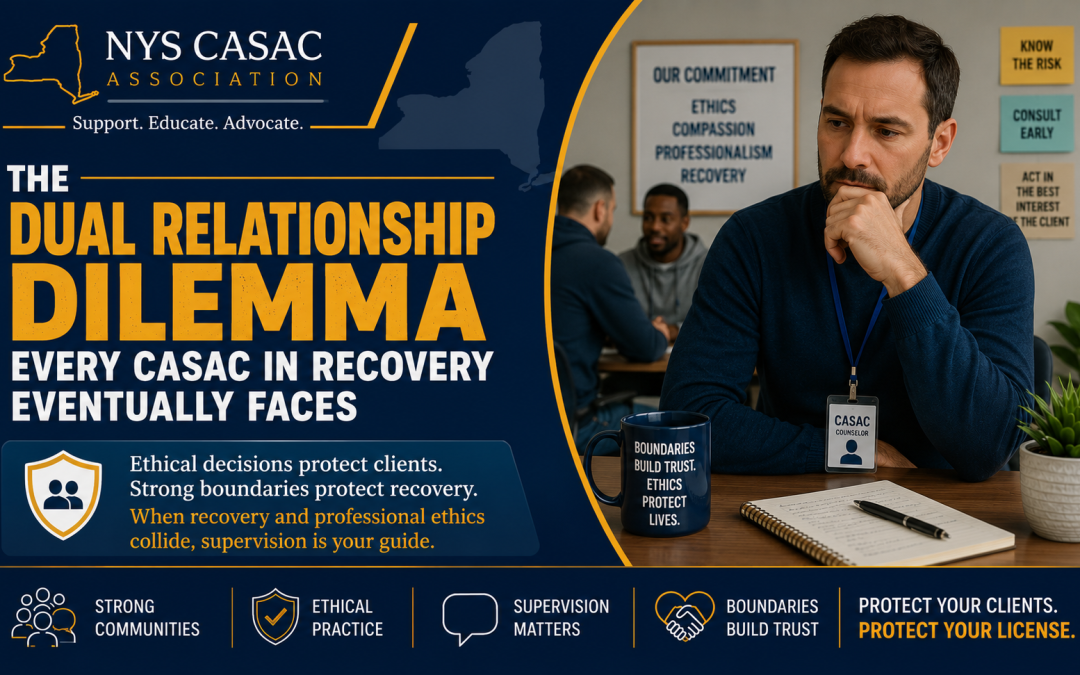
CASAC dual relationships require careful judgment when counselors and clients share recovery communities, personal history,
or overlapping social circles.
CASAC Dual Relationships in Recovery Communities
You walk into your home group before work.
A person smiles and walks toward you.
Then you realize they are on your afternoon schedule.
Nothing inappropriate has happened.
The ethical problem is already sitting in front of you.
This is a reality many CASACs understand but rarely discuss openly.
Counselors who entered this profession through their own recovery often work in the same communities where they rebuilt their lives. They attend the same meetings. They know the same people. They may recognize clients from shelters, treatment programs, recovery residences, or years spent surviving substance use disorder.
Private practice therapists often have the luxury of professional distance.
Many CASACs do not.
That difference deserves an honest conversation.
OASAS Part 853 leaves little room for confusion
New York’s credentialing regulations are clear.
The OASAS Part 853 Credentialing of Addictions Professionals regulations identify dual relationships as professional misconduct when they create conflicts of interest, exploit the client, or impair professional judgment. Credentialed professionals must avoid relationships that compromise objectivity or place the client at risk. The burden falls on the counselor to demonstrate that no exploitation occurred if a dual relationship is questioned. The regulation exists to protect clients, not counselors. (OASAS Part 853)
That sounds straightforward.
Real life rarely is.
Many CASACs cannot simply relocate to another city after entering recovery.
Many built their recovery through local meetings.
Many have family nearby.
Many work where treatment programs desperately need experienced counselors.
Recovery communities overlap.
Professional boundaries do not disappear because the overlap was unavoidable.
Lived experience changes the conversation
Lived experience is one of this profession’s greatest strengths.
It creates credibility.
It builds trust.
It helps counselors recognize things textbooks cannot teach.
I spent years homeless in Manhattan.
I knew shelters.
I knew treatment.
I knew the streets.
Those experiences helped me connect with people sitting across from me years later.
They also meant I occasionally recognized someone before reading their chart.
That changes the ethical map immediately.
Recognition alone is not misconduct.
Ignoring what follows can become misconduct.
The situations happen more often than people admit
CASAC dual relationships usually do not begin with dramatic ethical violations.
They begin with ordinary moments.
You recognize someone from an AA meeting.
A former roommate from supportive housing arrives for an intake.
Someone you once used substances with enters treatment.
A client’s sponsor is your sponsor.
A former treatment peer asks if you can become their counselor.
Your counselor from years ago becomes your coworker.
None of these situations automatically require the same response.
Each requires thoughtful assessment.
The question is never whether you know the person.
The question is whether the relationship changes your ability to provide objective clinical care.
Familiarity creates risks that are easy to underestimate
Most counselors believe they can remain objective.
Many can.
Objectivity is only one concern.
Confidentiality changes.
Power changes.
Client expectations change.
Your own emotional reactions change.
A client may expect special treatment because of shared history.
They may avoid discussing relapse because they fear disappointing you personally.
They may worry you remember things from years before treatment began.
The counselor carries different pressures.
You may protect the client from difficult feedback.
You may confront them more harshly because you already know their history.
You may unintentionally document assumptions instead of observations.
None of those decisions happen because you intended harm.
They happen because the relationship already existed before the clinical one began.
That is exactly what ethical boundaries are designed to prevent.
Ask better questions before accepting the case
Many counselors immediately ask one question.
“Can I handle this professionally?”
That is not enough.
Ask yourself:
- Do I know this person socially?
- Have we shared recovery meetings regularly?
- Have we lived together?
- Was there ever a financial relationship?
- Have we dated?
- Do we have mutual friends who know both of us?
- Will we continue seeing each other every week outside treatment?
- Could either of us struggle separating recovery from counseling?
These questions produce a much clearer picture.
The relationship needs to be mapped before the decision is made.
Not afterward.
Supervision is where difficult decisions become clear
Many counselors wait too long before involving a supervisor.
That is backwards.
The moment you recognize a possible dual relationship, bring it forward.
Not after the first session.
Not after a conflict develops.
Early.
The purpose of supervision is not to ask permission.
It is to examine your clinical judgment before it becomes clouded.
The OASAS Clinical Standards for certified programs describe supervision as an ongoing process that examines clinical work, ethical issues, staff performance, and treatment decisions. Ethical concerns belong there. They should not be worked out alone. (OASAS Clinical Standards)
Bring facts, not feelings
Walking into supervision saying, “I know this client,” is not enough.
Give your supervisor information they can evaluate.
Bring:
- How you know the person.
- How long ago the relationship existed.
- Whether the relationship was personal, professional, financial, or social.
- Whether you continue seeing each other outside treatment.
- Whether either of you has information that could affect counseling.
- Whether another counselor is available.
- Your own concerns about objectivity.
Then listen.
Sometimes the answer will be obvious.
Sometimes it will not.
That is why supervision exists.
Watch for your own reactions
Many ethical problems begin inside the counselor.
Not inside the client.
You feel protective.
You feel guilty.
You feel obligated.
You want to rescue them.
You become unusually frustrated.
You minimize a relapse.
You avoid difficult conversations.
Those reactions deserve attention.
That is not weakness. That is clinical data.
Your history can strengthen your work.
It can also hijack your judgment if it stays unexamined.
Some situations call for recusal
There is no universal rule that says every prior contact requires transferring the client.
There are situations where recusal becomes the cleanest ethical choice.
Examples include:
- A former romantic relationship.
- A close friendship.
- A previous financial relationship.
- Shared housing.
- Family connections.
- Active participation in the same small recovery group where regular contact cannot be avoided.
- Knowledge of highly personal information outside the clinical record.
The NAADAC Code of Ethics directs counselors to avoid multiple relationships that impair professional judgment or increase the risk of exploitation. It also recommends consultation and supervision whenever previous relationships exist. (NAADAC Code of Ethics)
Recusal protects the client.
It protects the counselor, too.
A transfer should never feel like rejection
Clients often misunderstand transfers.
Many hear one message.
“You do not want to work with me.”
That is not the message.
Explain the reason simply.
Protect confidentiality.
Protect dignity.
Protect trust.
A conversation might sound like this:
“We already know each other outside this professional relationship. I want you to receive care without divided roles or possible conflicts. Another counselor can provide that, and I will help make the transition smooth.”
Notice what is missing.
No lengthy explanation.
No discussion of your recovery history.
No apology.
No blame.
The focus stays where it belongs.
On the client.
The NAADAC Code of Ethics also requires counselors to avoid abandoning clients during transfers and to arrange appropriate continuity of care. (NAADAC Code of Ethics)
Documentation should explain your reasoning
Documentation should never become a diary.
It should never include unnecessary community history.
Write what affects treatment.
Record that a potential dual relationship was identified.
Document the supervision discussion.
Record the recommendation.
Document the final clinical decision.
If the client transfers, document the referral and continuity plan.
If treatment continues, document why the decision was clinically appropriate.
A reviewer should understand your reasoning without reading between the lines.
That is the standard.
Community encounters require planning
Working where you found recovery means public encounters will happen.
The grocery store.
The coffee shop.
A recovery meeting.
A neighborhood event.
The encounter itself is not misconduct.
Your response matters.
Do not greet the client first.
Allow them to decide whether to acknowledge you.
Do not discuss treatment.
Do not introduce them as your client.
Do not continue the clinical conversation.
Discuss these situations during informed consent.
Clients appreciate knowing what to expect before it happens.
That removes confusion later.
Recovery does not remove professional boundaries
My recovery opened the door to this profession.
It also placed me in communities where I occasionally recognized faces long before I opened a chart.
That reality never gave me permission to lower professional standards.
It demanded higher ones.
The strongest boundary is rarely built in the moment you recognize someone.
It is built in the supervision meeting that follows.
Bring the situation forward.
Map the relationship honestly.
Accept the answer, even when it creates extra work.
That protects the client.
That protects the profession.
Start with the NYS CASAC Association Code of Ethics. Then use the 10 Step Ethical Decision Making Model for Substance Use Counselors whenever a boundary question does not have an obvious answer. A steady process almost always produces a better decision than relying on instinct alone.
Join the NYS Association of CASAC Professionals.
Advance your career. Unify with peers. Advocate for the profession. Gain access to training, certification support, and a statewide network that strengthens both you and the CASAC workforce