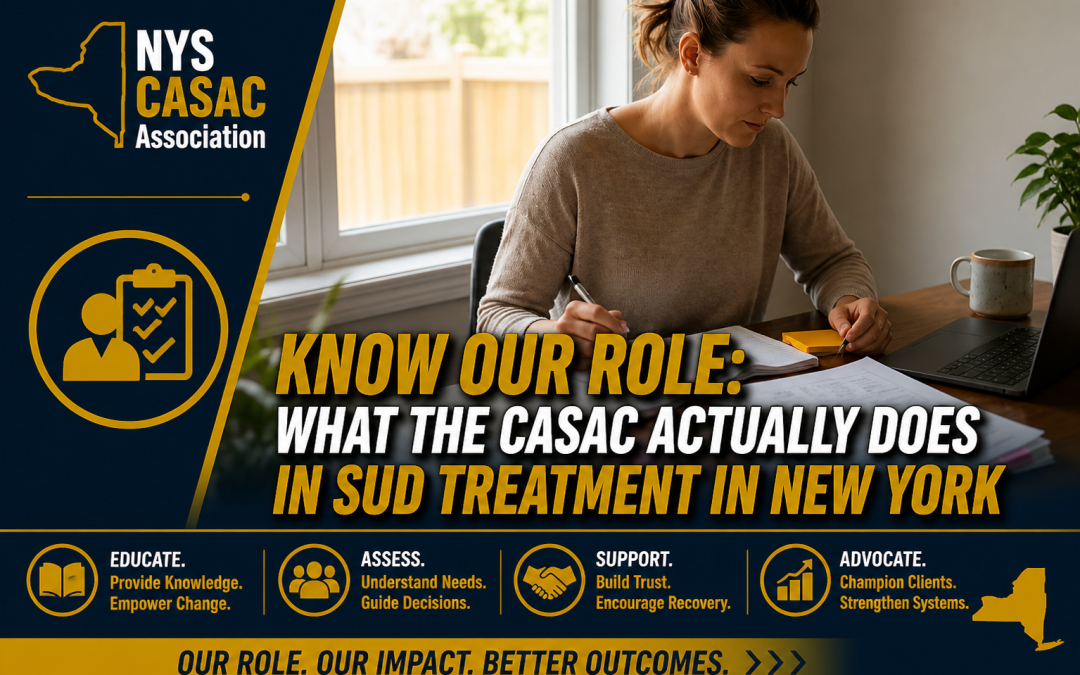
Start recognizing the importance and vital role of the CASAC clinician in substance use treatment in New York State
CASACs are the backbone of New York’s substance use treatment system. And it’s time we are recognized, supported, and elevated.
You hear it all the time, usually from people who have never sat in a session, never walked a client to detox, never watched someone shake through withdrawal, never had to decide whether a “I’m fine” is a lie or a warning sign.
They say CASACs “run groups.”
They say CASACs “do referrals.”
They say CASACs are “support staff.”
No.
CASACs are clinicians. Full stop.
A CASAC is trained to work with people who use substances, people in recovery, and people at high risk. You don’t just talk. You assess. You plan. You intervene. You document. You coordinate. You manage risk. You build motivation when someone has none. You help stabilize lives that are actively collapsing.
If you’re the public, if you’re an agency leader, if you’re a policymaker, if you’re a program director, you need to understand what CASACs actually do. Not for ego. For outcomes. Because when you misunderstand the role, you underfund it, understaff it, and burn out the workforce that holds the whole system together.
CASAC are clinicians, not “helpers.”
Clinical work is not defined by a degree title. It’s defined by responsibilities, ethical standards, and the ability to assess and intervene in real time.
CASACs deliver clinical care across the continuum: prevention, early intervention, outpatient, intensive outpatient, residential, detox coordination, reentry support, and recovery services. You are often the first professional someone trusts enough to tell the truth to.
And you do it inside real-world constraints: time pressure, staffing shortages, documentation demands, complex co-occurring mental health needs, housing instability, legal involvement, and the fentanyl-era risk environment.
Calling a CASAC “support staff” is not just disrespectful. It’s clinically dangerous. It leads organizations to build workflows that ignore the role’s complexity, and it leads to staffing models that guarantee turnover.
Screening: the first clinical filter
CASACs meticulously evaluate individuals’ substance use patterns, identifying potential risk factors and underlying causes. They assess each person’s readiness and motivation for change, considering personal circumstances. Based on this comprehensive assessment, they develop customized interventions, including counseling, education, and support strategies, to facilitate recovery and encourage sustainable, healthier lifestyles.
That includes identifying red flags fast:
-
Recent overdose or near overdose
-
Polysubstance use
-
Withdrawal risk
-
Suicidal thinking or acute psychiatric instability
-
Violence risk or immediate safety issues
-
Pregnancy considerations
-
Medical risk factors that change everything
Screening is not “asking if someone uses.” It’s reading the room. It’s catching what the client is minimizing. It’s knowing when to slow down and when to move fast. It’s making the call that keeps a client alive long enough to get stabilized.
Assessment support: the work that turns chaos into a clinical picture
Many clients arrive with complex, often confusing narratives that can seem overwhelming or disorganized. CASACs play a crucial role in helping to organize and interpret these stories, transforming what initially appears to be chaos into a coherent, usable clinical picture. This process enables effective assessment and tailored treatment planning.
You gather details that matter:
-
History of use, routes, frequency, and context
-
Triggers and patterns
-
Prior treatment attempts and what worked
-
Trauma exposure and stress load
-
Family systems and support
-
Legal involvement and mandated requirements
-
Employment, housing, and barriers
-
Mental health symptoms that may be driving use
-
Protective factors and strengths
You don’t do this to label people. You do it to build a plan that fits the person in front of you. Because generic treatment plans fail. People don’t relapse because they “forgot recovery.” They relapse because the plan didn’t match reality.
Treatment planning: turning goals into trackable actions
CASACs are not simply creating plans to check off a box or fill in a chart. Instead, they develop comprehensive strategies aimed at reducing risks and enhancing follow-through, ensuring that their interventions are effective and outcomes are improved.
That means:
-
Identifying a realistic primary goal
-
Breaking it into short, measurable steps
-
Building coping strategies that match the client’s actual triggers
-
Preparing for high-risk moments before they happen
-
Documenting barriers without blaming the client
-
Making the plan usable outside the office
A good CASAC plan doesn’t just say “avoid people, places, and things.” It names them. It maps the time windows. It builds the first 60-second response. It includes a “slip plan” that prevents the shame spiral and helps the client get back to care quickly.
Group facilitation: clinical work in real time
Groups are not babysitting sessions. Groups are clinical interventions.
CASACs facilitate groups that teach skills, build insight, reduce isolation, and challenge distorted thinking without shaming people. You manage group dynamics, conflict, disclosure risk, and safety in the room. You catch escalation before it becomes chaos. You pull meaning out of the moment.
You also do something that’s hard to quantify: you create a space where someone can say, “I’m not okay,” and not get punished for it.
That is clinical leadership.
Recurrence of Symptoms (Relapse prevention): the part that keeps people alive between sessions
Recurrence of Symptoms (Relapse prevention) isn’t just a lecture; it involves strategic planning for predictable moments when the brain tends to fall into autopilot, often triggered by symptom recurrence. Recognizing these patterns helps in developing effective coping strategies.
CASACs help clients:
-
Identify early warning signs
-
Map triggers with precision
-
Rehearse coping responses
-
Build support lists that are real, not fantasy
-
Develop routines that reduce impulsive risk
-
Create emergency steps when cravings peak
This is especially critical in the fentanyl era. One relapse can be fatal. That changes the urgency of prevention work. CASACs carry that urgency every day.
Discharge planning: ending treatment without dropping the person
Discharge should not be viewed as simply ‘good luck out there.’ Instead, it is a carefully managed clinical transition that can significantly influence a patient’s health trajectory. Proper management of this phase can mitigate risks, prevent complications, and improve recovery outcomes, underscoring its importance beyond mere release.
CASACs coordinate:
-
Step-down care and continuing treatment
-
Recovery supports and mutual aid options that fit the client
-
Medication continuity, where applicable
-
Housing and basic needs support
-
Employment and training resources
-
Referrals that actually get completed
-
Relapse prevention plans that survive the real world
A clean discharge plan helps prevent revolving-door treatment. It’s how you prevent a client from leaving care and falling into the same environment with zero support.
Crisis stabilization and reentry coordination: the front-line work nobody wants to claim
CASACs are essential frontline responders in crisis situations. Their responsibilities include de-escalating potentially volatile scenarios, developing safety plans tailored to individual needs, providing overdose education, and administering naloxone training. They also coordinate immediate interventions when clients are at imminent risk, balancing risk management with maintaining rapport, trust, and client dignity in high-pressure moments.
And CASACs are essential in reentry work. People coming home from jail or prison face immediate relapse risk because the transition is brutal: stress, triggers, limited support, and often reduced tolerance.
Reentry coordination means:
-
Connecting to treatment quickly
-
Bridging to housing and benefits
-
Navigating legal obligations
-
Rebuilding structure before chaos returns
-
protecting the person during the highest-risk window
This is not “extra.” This is life-saving.
Here’s the bottom line
This is why acknowledging, supporting, and elevating CASACs is crucial.
They are the backbone of New York’s addiction treatment system, driving engagement, reducing relapse risk, and holding the entire system together. Investing in their training and development is investing in the success of the entire system. When we recognize the vital role CASACs play, we strengthen our collective efforts and create a more effective, compassionate system of care.
Together, we are stronger, louder, and more impactful. The voice of CASACs begins here, and it is time to listen, support, and empower.
Join the NYS Association of CASAC Professionals.
Advance your career. Unify with peers. Advocate for the profession. Gain access to training, certification support, and a statewide network that strengthens both you and the CASAC workforce
Stay Connected With NYS-CASAC Association NEWS
Don’t miss the updates, spotlights, and resources shaping addiction counseling in New York. Join the NYS Association of CASAC Professionals today for full access to announcements, newsletters, and advocacy news that strengthen your voice and career.