CASACs are the backbone of New York’s addiction treatment system. And it’s time we are recognized, supported, and elevated.
A lot of the public conversation about addiction treatment is built on bad assumptions. Not harmless misunderstandings. Assumptions that shape budgets, staffing, program design, and how clients are treated when they struggle.
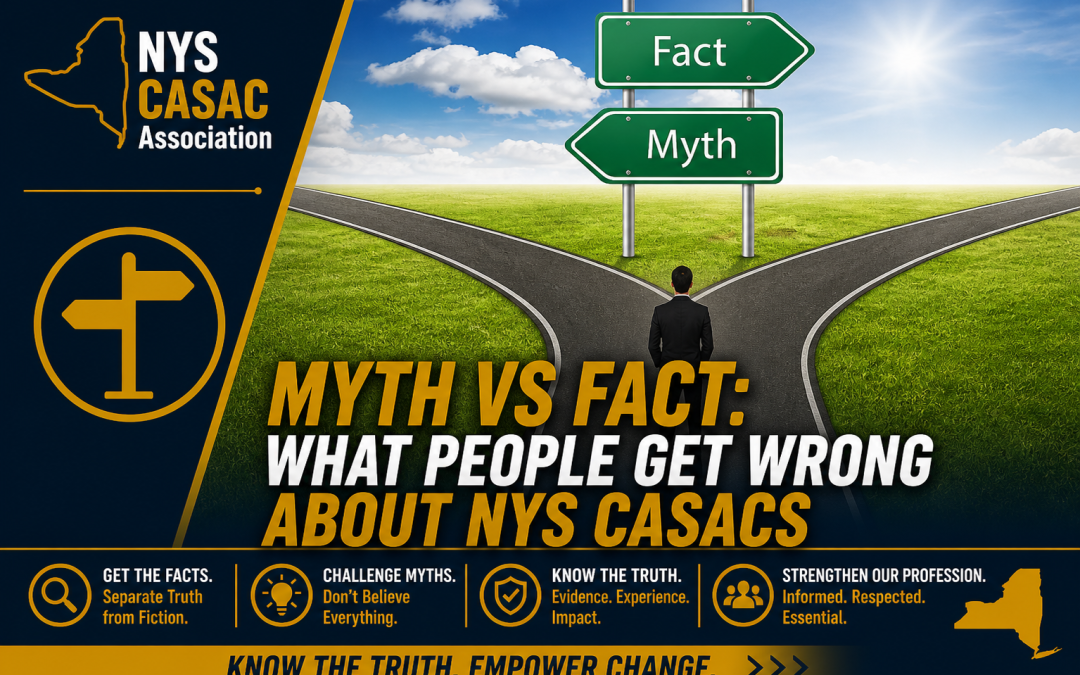
People talk about addiction treatment as if it runs on slogans. It doesn’t. It runs on a workforce. CASACs carry the hardest part of the system: engagement, risk management, relapse prevention, crisis stabilization, and continuity of care. Yet the public and even agencies still repeat myths that shrink the role and justify underfunding it. Those myths don’t just disrespect CASACs. They shape staffing, policy, and outcomes. Let’s correct the record and name the work.
So let’s clean up and debunk some common myths held by politicians, treatment programs, behavioral health professionals, and the general public about the NYS CASAC certification.
CASAC Workscope myths
CASAC workscope myths don’t just sound ignorant. They shape how agencies staff programs, how funders allocate dollars, and how the public judges outcomes. When people reduce CASACs to “group runners” or “referral people,” they erase the clinical skill behind engagement, risk management, relapse prevention, crisis response, and continuity of care. That erasure turns into under-resourcing, unrealistic expectations, and burnout. If you want better treatment outcomes in New York, you start by getting the role right.
Myth #1: “CASACs just run groups.”
Fact: CASACs manage risk, motivation, relapse prevention, and engagement across the continuum.
Groups are one tool. They are not in the role.
CASACs do clinical work that directly impacts safety and outcomes, including:
-
Risk management: catching withdrawal risk, overdose risk, suicide risk, violence risk, and relapse risk before it becomes an emergency
-
Engagement: building rapport with clients who don’t trust systems, don’t trust providers, and often don’t trust themselves
-
Motivational work: helping a client move from “I’m only here because I have to be” to “I might actually want something different.”
-
Relapse prevention planning: mapping triggers, warning signs, and the first 60 seconds plan that keeps people alive in high-risk moments
-
Treatment planning support: turning vague goals into measurable steps, and adjusting when reality changes
-
Discharge and reentry coordination: connecting people to continuing care, housing supports, recovery resources, and safer transitions
CASACs operate across levels of care. Detox. Outpatient. Residential. Reentry. Crisis response. Harm reduction. Recovery support.
If you reduce that to “just groups,” you’re not describing the job. You’re erasing it.
And when the role gets erased, the workforce gets underfunded, understaffed, and burned out. Clients pay for that in missed care and disrupted relationships.
Myth #2: “If someone relapses, treatment failed.”
Fact: relapse risk is predictable. Systems reduce risk. Shame increases it.
Relapse doesn’t mean treatment was useless. It usually means one of two things happened:
-
Risk wasn’t fully addressed.
Triggers, mental health, housing instability, untreated pain, social pressure, or the drug supply itself. The environment stayed dangerous, and the coping plan wasn’t strong enough for the moment.
-
The system treated relapse as a moral violation rather than as clinical data.
When relapse is met with shame, punishment, or discharge threats, clients learn a simple lesson: hide it. Lie about it. Avoid care. Use alone.
That’s how relapse becomes overdose.
A clinical response treats relapse risk like weather. Predictable patterns. Warning signs. High-risk windows. Prevention planning. Rapid re-engagement when someone slips.
A good system does not ask, “Why did you mess up?”
A good system asks, “What changed? What warning signs did we miss? What support needs to tighten up right now?”
And a good CASAC knows the difference between accountability and humiliation.
Accountability builds recovery.
Humiliation fuels relapse.
The takeaway
If you want better outcomes in New York, stop repeating myths that weaken the workforce and shame the client.
CASACs are clinicians. CASACs are risk managers. CASACs are engagement specialists. CASACs are relapse prevention strategists.
CASACs are the backbone of New York’s addiction treatment system. And it’s time we are recognized, supported, and elevated.
Myth #3: “CASACs just do referrals.”
Fact: CASACs do clinical engagement and care coordination that makes referrals actually happen.
A referral is not a plan. It’s a handoff. And handoffs fail all the time.
CASACs are the difference between:
-
“Here’s a phone number.”
and
-
“You actually show up, get admitted, and stay long enough to stabilize.”
What CASACs do in the middle matters:
-
build rapport so the client doesn’t disappear after the appointment is scheduled
-
Identify barriers like transportation, insurance gaps, fear of withdrawal, childcare, warrants, and domestic violence risk
-
coordinate releases of information, calls with intake teams, and follow-up confirmation
-
prepare the client for what to expect so panic doesn’t turn into a no-show
-
track whether the referral landed and adjust quickly if it didn’t
Referrals don’t save lives by themselves. Engagement and coordination do.
Myth #4: “CASACs only work in outpatient.”
Fact: CASACs work across detox, residential, outpatient, reentry, and crisis settings, as well as recovery support programs.
CASACs are everywhere in the system when it is under pressure.
Detox: stabilizing, education, safety planning, motivation, transition planning.
Residential: treatment planning, groups, relapse prevention, and discharge planning.
Outpatient: engagement, skill-building, relapse prevention, coordination, continuity.
Reentry: overdose risk planning, fast linkage to care, rebuilding structure.
Crisis settings: de-escalation, triage, safety steps, rapid linkage.
Recovery support programs: sustained engagement, coaching toward stability, preventing drop-off.
If you only picture “outpatient counseling,” you’re missing how central CASACs are to the entire continuum of care.
Myth #5: “CASACs are only needed once someone is ‘ready.’”
Fact: CASACs specialize in motivation and engagement when someone is ambivalent, mandated, or shutting down.
Most people don’t walk into treatment ready. They walk in pressured, scared, angry, exhausted, or half-committed.
That’s not a reason to give up on them. That’s the moment CASAC skills matter most.
CASACs know how to:
-
work with ambivalence without turning it into a power struggle
-
reduce shame so honesty becomes possible
-
build a plan that fits the client’s real life, not an ideal life
-
Create small wins that increase momentum
-
keep someone engaged through early instability, the highest-risk phase
“Readiness” is not a prerequisite. It’s something that gets built in treatment.
The takeaway
CASACs don’t “just do referrals.”
CASACs don’t “only work outpatient.”
CASACs aren’t “only for clients who are ready.”
CASACs are clinicians who keep people engaged, stabilized, and connected to the next right step.
CASACs are the backbone of New York’s addiction treatment system. And it’s time we are recognized, supported, and elevated.
Myth vs Fact: Pay, Value, and the CASAC Workforce
Let’s be direct about what’s happening in New York’s addiction treatment workforce.
CASACs are asked to carry high-risk clinical work in an era of fentanyl, polysubstance use, and rising co-occurring mental health needs. You’re expected to keep clients engaged, manage relapse risk, stabilize crises, coordinate transitions, and document everything with precision. You’re also expected to do it under staffing shortages, high caseloads, and constant pressure to move faster.
Now look at what the system pays and how it talks about the role.
When pay and recognition don’t match responsibility, you get predictable outcomes: turnover, vacancies, inconsistent care, longer waitlists, lower morale, and more clinical risk. Clients feel that instability immediately. So do programs.
That’s why we need to confront the myths that keep CASAC compensation low and the workforce unstable. Not as a complaint. As a workforce and quality-of-care issue.
Let’s talk about two of the biggest ones.
Myth #1: “CASACs are entry-level, so low pay makes sense.”
Fact: CASACs manage high-risk clinical work. Pay should reflect impact and responsibility.
CASAC work is not low-stakes. It’s not “starter work.” It’s frontline clinical care in the fentanyl era.
CASACs manage:
-
overdose risk and relapse risk
-
crisis stabilization and safety planning
-
high-acuity caseloads with co-occurring mental health needs
-
engagement with clients who distrust systems and are often mandated
-
treatment planning, group facilitation, discharge planning, and reentry coordination
This work requires clinical judgment under pressure. The responsibility is real. The outcomes are real. When pay doesn’t match the risk and responsibility, people leave. When people leave, continuity of care collapses. And clients pay the price.
Low pay doesn’t “save money.” It creates turnover costs, care gaps, and worse outcomes.
Myth #2: “The job is rewarding, so compensation isn’t the point.”
Fact: Meaning doesn’t pay rent. Underpaying the workforce damages care.
Yes, the work matters. Yes, it can be deeply meaningful. That’s exactly why this myth is so manipulative.
If a system depends on people’s compassion to justify low pay, it’s not a healing system. It’s an extraction system.
Meaning doesn’t cover:
-
rent and mortgages
-
childcare
-
student loans
-
transportation
-
health care
-
emergency expenses
Underpaying the workforce forces clinicians into burnout math: extra shifts, side jobs, constant stress, less recovery time, less patience, less bandwidth. That doesn’t just hurt CASACs. It hurts clients.
You can’t build a stable treatment system on exhausted professionals who can’t afford their own lives.
The takeaway
CASACs are not “entry-level.”
CASACs are not “paid on purpose.”
CASACs are clinicians doing high-risk work.
CASACs are the backbone of New York’s addiction treatment system. And it’s time we are recognized, supported, and elevated.
Conclusion
If you want better outcomes in New York, stop building systems on myths. CASACs are clinicians. CASACs manage risk. CASACs keep people engaged when they’re ambivalent, mandated, or shutting down. CASACs make referrals, transitions safer, and relapse prevention real. And when the workforce is underpaid, overlooked, and burned out, continuity of care collapses. This is the bottom line: CASACs are the backbone of New York’s addiction treatment system. Recognition, support, and elevation are not optional.
Stronger together. Louder together.
The voice of CASACs starts here.
Join the NYS Association of CASAC Professionals.
Advance your career. Unify with peers. Advocate for the profession. Gain access to training, certification support, and a statewide network that strengthens both you and the CASAC workforce
Stay Connected With NYS-CASAC Association NEWS
Don’t miss the updates, spotlights, and resources shaping addiction counseling in New York. Join the NYS Association of CASAC Professionals today for full access to announcements, newsletters, and advocacy news that strengthen your voice and career.