News Brief: New Synthetic Opioid Identified in Upstate New York Raises Serious Safety Concerns
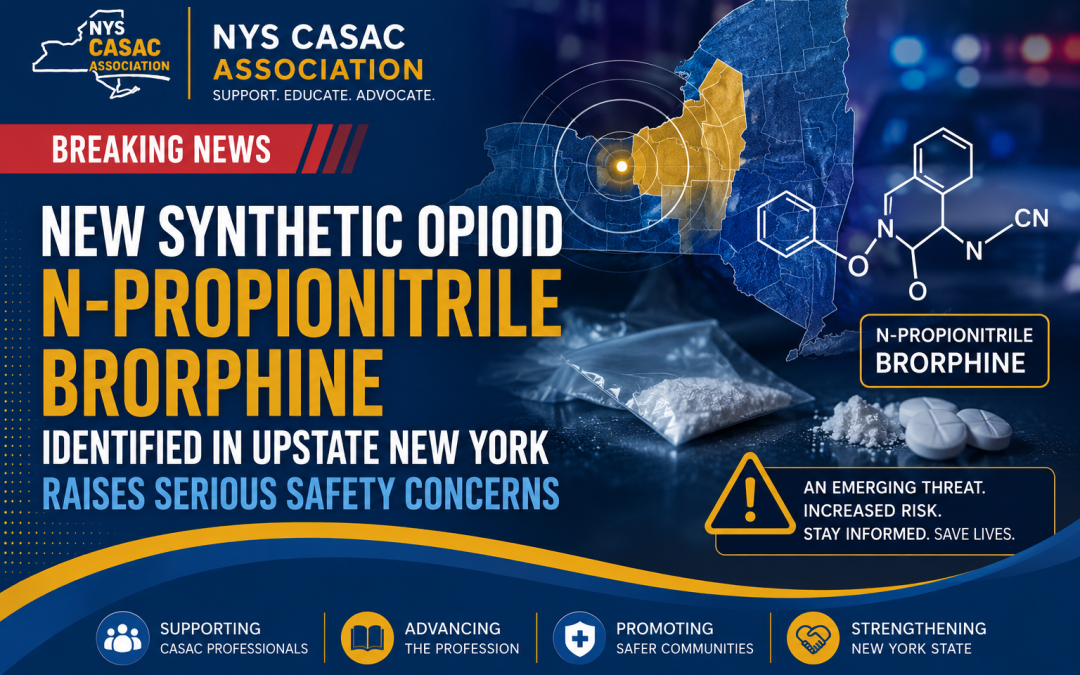
The New York State Department of Health has issued a Public Health Alert after identifying N-propionitrile brorphine, a newly emerging synthetic opioid, in the illicit drug supply in Upstate New York. Announced on July 1, 2026, the alert warns that the substance has been found mixed with fentanyl and medetomidine, meaning people who believed they were using those substances were often unaware that this additional synthetic opioid was present.
N-propionitrile brorphine belongs to a newer class of laboratory-produced opioids known as “orphines.” While researchers have not yet determined its exact potency, it is structurally related to cyclorphine, a compound believed to be even more potent than fentanyl. Health officials are particularly concerned that the drug may cause prolonged sedation, increasing the risk of respiratory depression and making overdose responses more complex.
For CASACs and other addiction professionals, this alert underscores the rapidly evolving nature of today’s illicit drug supply. Clients may be exposed to substances they never intended to use, making overdose education, harm reduction, and ongoing assessment more important than ever. Counselors should continue encouraging clients to utilize drug-checking services when available, avoid using substances alone, carry naloxone, and understand the importance of rescue breathing and maintaining an open airway during an overdose emergency.
This alert also serves as another reminder that overdose response extends beyond naloxone administration. Individuals should be closely monitored after naloxone is given, particularly when newer synthetic opioids or sedating adulterants may be involved.
The NYS Association of CASAC Professionals encourages all members to remain informed about emerging substances and to continue providing evidence-based education that helps reduce overdose risk and save lives.
Read the full Public Health Alert from the New York State Department of Health and OASAS for additional clinical guidance and safety recommendations.