News Brief: SAMHSA issues new federal funding restrictions on harm reduction supplies (April 24, 2026)
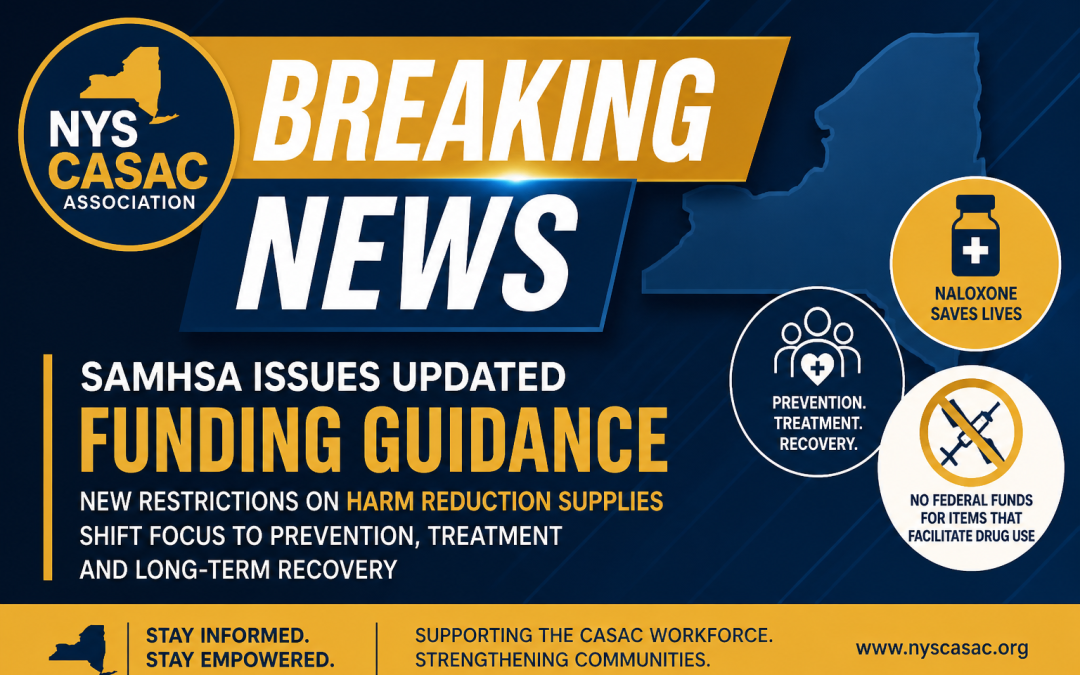
On April 24, 2026, SAMHSA released an updated “Dear Colleague” guidance letter that changes how SAMHSA discretionary grant funds may be used for harm reduction–related supplies and services. The letter signals a clear federal policy shift away from funding items that SAMHSA says could “facilitate illicit drug use,” while continuing to support overdose reversal and certain infectious disease prevention services.
What’s changing
SAMHSA states that it is moving away from harm reduction practices it views as incompatible with federal law, and it notes the guidance is aligned with the Administration’s priorities and the Executive Order on “Ending Crime and Disorder on America’s Streets.”
Importantly, SAMHSA also signals that this approach is intended to be consistent across HHS, with adoption referenced across other divisions.
What federal funds can still support?
Under the updated guidance, SAMHSA funding can continue to support a range of life-saving and prevention services, including:
- Opioid overdose reversal medications such as naloxone and nalmefene, along with distribution mechanisms and training/education on overdose reversal
- Medication lock boxes and medication disposal kits
- Certain infectious disease prevention supports, including wound care supplies, sharps disposal kits, and FDA-approved home testing kits for HIV and viral hepatitis
- Navigation/linkage to prevention and treatment services such as PrEP/PEP, HIV care, and hepatitis-related services, including referrals for hepatitis A and B vaccination
- Nicotine cessation therapies and condom distribution
What federal funds can no longer support
The guidance states federal funds may not be used for items SAMHSA characterizes as promoting or facilitating illicit drug use, including:
- Syringes/needles and pipes or “safer smoking kit” supplies
- Drug checking/test strips intended for use by individuals (including fentanyl and xylazine test strips), with an important exception noted for professional use by certain responders/health professionals in their official capacity
- Other “facilitation” supplies referenced in the guidance (examples discussed in secondary summaries include sterile water/saline/ascorbic acid)
- “Overdose hotline” companion/virtual services are described as facilitating illicit drug use
Why this matters for NYS programs and counselors
For New York providers and community partners, this is not just a federal memo. It can create immediate operational impacts for any initiative that relies on federal grant dollars for harm reduction purchasing, distribution, or outreach workflows.
For counselors, the clinical reality doesn’t change: fentanyl-driven overdose risk remains high, and clients still need practical safety planning. What may change is how programs fund and supply certain tools, which can shift what is available at the point of care and what must be supported through non-federal funding streams.
What to do next
- Program leadership: review all SAMHSA-funded budgets and line items for compliance, especially supplies distributed directly to participants.
- Clinical teams: update your referral list for naloxone access, HIV/HCV testing options, and wound care resources that remain allowable under the guidance.
- Document impact: if service delivery changes, track how engagement, overdose risk, and referral follow-through change so the field can report real downstream effects.