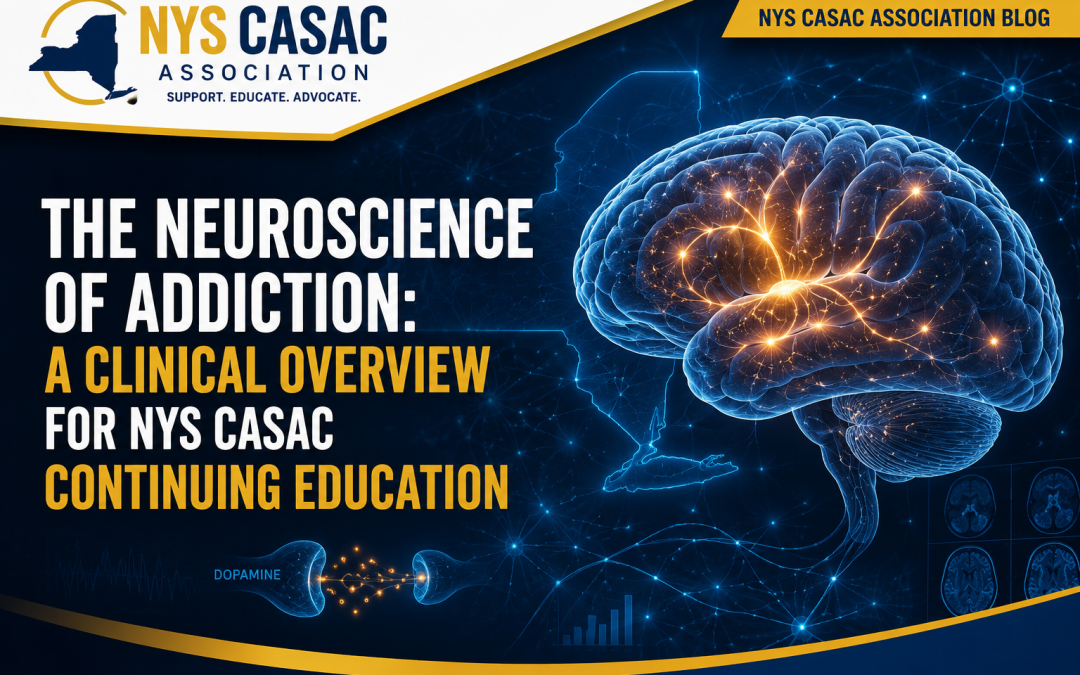
The Neuroscience of Addiction: A Clinical Overview for NYS CASAC Continuing Education
The brain research on substance use disorder has moved fast in the last decade.
For credentialed CASAC professionals, staying current on this research is not just a box on a continuing education checklist. It changes how you read your clients. It changes how you explain the disorder to families. And it changes how you push back against stigma in your practice settings.
This post covers three clinical areas: the dopamine and reward system disruption that drives craving; prefrontal cortex impairment and its direct implications for client behavior; and what current recovery research shows about how the brain heals over time. Each has a direct application to practice. Each belongs in serious CASAC continuing education in the neuroscience of addiction.
The Dopamine System: What Drives Craving and Why It Persists
The brain’s reward system runs on dopamine. When a person eats, has sex, or connects with another person, the brain releases dopamine into the nucleus accumbens, the brain’s pleasure center. The signal: this was worth doing. Do it again.
Substances like heroin, alcohol, and cocaine hit the same system. They do it faster and in greater volume than almost any natural experience can. Over time, the brain compensates by reducing its sensitivity to dopamine, thereby reducing tolerance. The substance produces less effect per use. More is needed, more often, just to maintain baseline functioning.
Here is the clinical piece that gets under-taught: the research distinguishes between “liking” and “wanting.” Over time, a person with a substance use disorder stops liking the drug the way they once did. The wanting. The craving does not decrease with it. Craving increases. These are separate neurological systems, and the craving system is older, deeper, and more resistant to change.
What this means in practice: a client who reports intense craving months into recovery is not describing a motivation problem. They are describing a brain that was reorganized around a substance. The reward circuitry does not reset on a timeline tied to a client’s stated desire to stop. This is not failure. It is biology.
For NYS CASAC professionals, the neuroscience of addiction is CASAC continuing education that reframes this. Craving is not a symptom to argue with. It is a neurological state around which to build a clinical response.
Prefrontal Cortex Impairment: The Clinical Implications
The prefrontal cortex manages planning, judgment, and impulse control. Substance use disorder reduces activity in this region. Brain imaging studies make it visible: the prefrontal cortex in a person with an active substance use disorder shows less activity than that of a healthy control.
Every CASAC working in direct practice encounters the clinical result of this. The client who makes commitments and breaks them. The client who identifies a trigger, plans for it, and then walks straight into it. The client who says, clearly and with apparent sincerity, that they want to stop, and then does not.
This is not a default explanation of deception. This is reduced prefrontal function in real time.
The clinical response to prefrontal impairment is structural support, not lectures about commitment or motivation. Check-ins. Concrete, short-term plans. Accountability systems that do the work the prefrontal cortex cannot yet do reliably on its own. The counselor’s role in early recovery is, in part, to serve as an external prefrontal cortex until the client’s own begins to recover.
Prefrontal cortex function improves with sustained abstinence or reduced use. The timeline is months, not days. Early recovery is not the time to remove structure and test autonomy. It is time to build the scaffold.
What the Recovery Research Actually Shows
The most documented evidence on brain recovery comes from methamphetamine use disorder research.
At one month of abstinence, dopamine transporter levels in the brain’s reward center remained significantly reduced. The brain was still showing the disorder.
At 14 months, those levels had returned to nearly normal.
Fourteen months. That is the biological timeline the research supports, not 30 days, not 90. A realistic clinical picture of recovery as a neurological process takes this seriously.
For alcohol and cannabis, the research is still developing. Sustained abstinence from alcohol is associated with improved executive functioning and increased brain matter volume. Cannabis abstinence research shows some cognitive improvement, with mixed results. The honest clinical summary: alcohol and cannabis do produce neurological effects, some of which are reversible with sustained abstinence, and the research is still clarifying the extent and timeline.
What shows up consistently across substance types: physical exercise supports brain recovery. It increases cerebral blood flow, strengthens white matter integrity, and supports neuroplasticity. The brain’s capacity to build new pathways after damage. For NYS CASAC professionals doing individualized service planning, this is an evidence-based rationale for including physical activity. Not as a lifestyle suggestion, but as a component of neurological recovery.
Using Neuroscience in Clinical Practice
The neuroscience of addiction is CASAC continuing education that pays off directly in session.
When you know how the dopamine system was reorganized, you stop reading craving as a sign of poor commitment. When you know what prefrontal impairment looks like clinically, you stop reading relapse as betrayal. When you know the 14-month timeline from the recovery research, you stop expecting the brain to have healed on the treatment center’s schedule.
And when clients ask why it still feels like they want it even though they made a decision to stop, you have an honest answer.
You are not broken. Your brain was reorganized around a substance. That reorganization changes slowly. Here is what the research shows about what helps.
That is what a CASAC continuing education in the neuroscience of addiction gives you. Not just credit hours. A clinical frame that works.
NYS CASAC Association members can access continuing education resources grounded in current addiction research at nyscasacassociation.net. Your credential is a commitment to current, evidence-based practice. Neuroscience is part of it.
Join the NYS Association of CASAC Professionals.
Advance your career. Unify with peers. Advocate for the profession. Gain access to training, certification support, and a statewide network that strengthens both you and the CASAC workforce