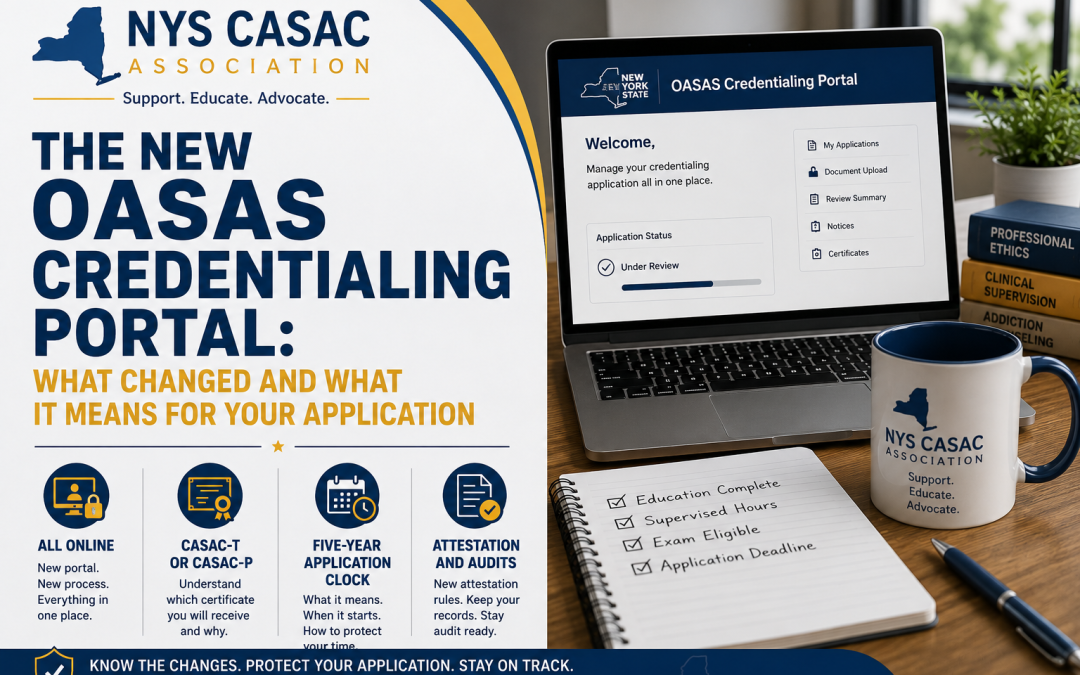
The OASAS credentialing portal now controls applications, review summaries, document uploads, certificates, extensions, and applicant deadlines.
The New OASAS Credentialing Portal: What CASAC T and CASAC P Applicants Need to Know
You submit your CASAC application.
Then the clock starts.
Many applicants still think the process works like the old paper system. Mail the forms. Wait for a letter. Send another envelope. Keep copies in a folder.
That process is mostly gone.
The OASAS credentialing portal now holds your application, review summaries, notices, document uploads, and exam information. Applicants need a valid NY.gov ID to enter the system. An existing account used for another New York State service can provide access.
The technology changed.
The rules changed with it.
Your portal is now your application file
OASAS directs applicants to start through the credentialing portal. Your review summary appears there after the Credentialing Unit examines your submission.
That review summary tells you what OASAS accepted. It lists what remains incomplete. Each later submission can produce an updated summary. OASAS permits applicants to upload new material throughout the active application period without another processing fee.
Do not rely on email alone.
An email tells you something entered the portal. The portal holds the document that matters.
Log in. Read every line. Save copies.
Paper applications still exist by request, but they cost more. OASAS lists a $100 online application fee and a $150 paper submission fee. Documents submitted after initial paper processing still need to be entered into the portal.
So paper does not remove the digital process.
It delays your entry into it.
CASAC T and CASAC P are not interchangeable
The CASAC Trainee certificate and CASAC Provisional certificate both show that an applicant has completed part of the CASAC process.
Neither one is the full CASAC credential.
A CASAC T applicant can qualify through the required education route or through the work experience and partial education route listed by OASAS. The common education route requires 350 clock hours and the mandatory one time training requirements.
The CASAC P follows a different entry path.
You need:
- A bachelor’s or master’s degree in an approved human services field
- An official college transcript
- The mandatory one-time training requirements
- A completed Verification of Employment or Intent to Hire form
- An approved background check
The employment form matters. OASAS states that applicants who omit it will receive consideration for CASAC T status instead.
The CASAC P has the same scope of practice as the CASAC T. It carries one major restriction. A CASAC P can work only in an OASAS-certified setting.
OASAS issues only one of these certificates. An applicant who qualifies for both will usually receive the CASAC T. The CASAC T permits work across more types of treatment settings.
Your degree does not automatically make the CASAC P better.
The work setting controls the value.
The five-year clock starts after the first review
Your application stays active for five years from the date OASAS completes its first review.
Not the date you open an account.
Not the date you start training.
Not the date you begin employment.
The first review starts the clock.
This changes when you should apply.
Submitting too early can waste part of your five-year period. OASAS states that the best time to apply is after completing a 350-hour program or after your college degree has been conferred. That timing places you in a stronger position to finish before expiration.
Five years sounds generous.
Work hours accumulate slowly. Supervisors leave. Programs close. Forms come back incomplete. Exam attempts take time.
The clock keeps running.
Check your original review date today. Do not estimate it from memory.
The extension is not automatic
A CASAC T or CASAC P applicant can receive one three-year extension.
There is a condition.
You must become exam eligible before the five-year application expires. OASAS bases exam eligibility on completion of the 350 education hours and mandatory one-time requirements. Work experience remains a separate credentialing requirement.
The extension costs $100.
Applicants who are not exam eligible at expiration need a new application, new supporting material, and another processing fee. OASAS states that CASAC T and CASAC P certificates receive one-time issuance. They are not issued a second time after a later application.
That is the hard edge of the rule.
Do not treat exam eligibility as a last-minute task.
If your expiration date is close, compare your review summary against every education requirement. Contact the Credentialing Unit through the portal or by email. Request the extension before your file falls out of active status.
Attestation does not mean records no longer matter
The updated Part 853 rules created attestation options for credential renewal. Renewal applicants can attest to completing the required 60 education hours. OASAS replaced the prior competency and professional conduct evaluation with an attestation. The agency conducts random monthly audits of those attestations.
That rule applies to renewals.
Initial CASAC applicants still need documents supporting claimed education. OASAS requires transcripts or approved certificates that show the applicant’s name, provider, course title, completion date, and clock hours.
An attestation is not permission to discard certificates.
It shifts responsibility onto you.
A renewal applicant selected for audit needs records that support every claimed hour. Missing certificates can turn a routine renewal into a credential problem.
Build one digital folder. Store every certificate. Name files by date, provider, course, and hours. Keep a second copy outside your work computer.
Paperwork gets weaponized fastest when nobody can find it.
Your next move is simple
Open the OASAS credentialing portal.
Find your first review date. Read your newest review summary. List every missing item. Confirm your exam eligibility status. Check the expiration date on your CASAC T or CASAC P certificate.
Do that before another training or work shift adds more load.
The NYS CASAC Association professional standards can help you track the duties attached to your credential. Applicants still completing their education can review the CASAC 350 Education and Training requirements before submitting documents to OASAS.
The new system is not hard once you map it.
The danger is assuming the clock stopped.
Join the NYS Association of CASAC Professionals.
Advance your career. Unify with peers. Advocate for the profession. Gain access to training, certification support, and a statewide network that strengthens both you and the CASAC workforce