Burnout or Vicarious Trauma? Why the Difference Matters for CASACs
Burnout and vicarious trauma are used as synonyms in most wellness content written for counselors. They are not in the same condition. They come from different sources, show up in different ways, and the fix for one will not touch the other. If you work in substance use disorder counseling, you need to know which one you are carrying. The wrong fix wastes your time and leaves the real problem untreated.
Two Conditions, Not One
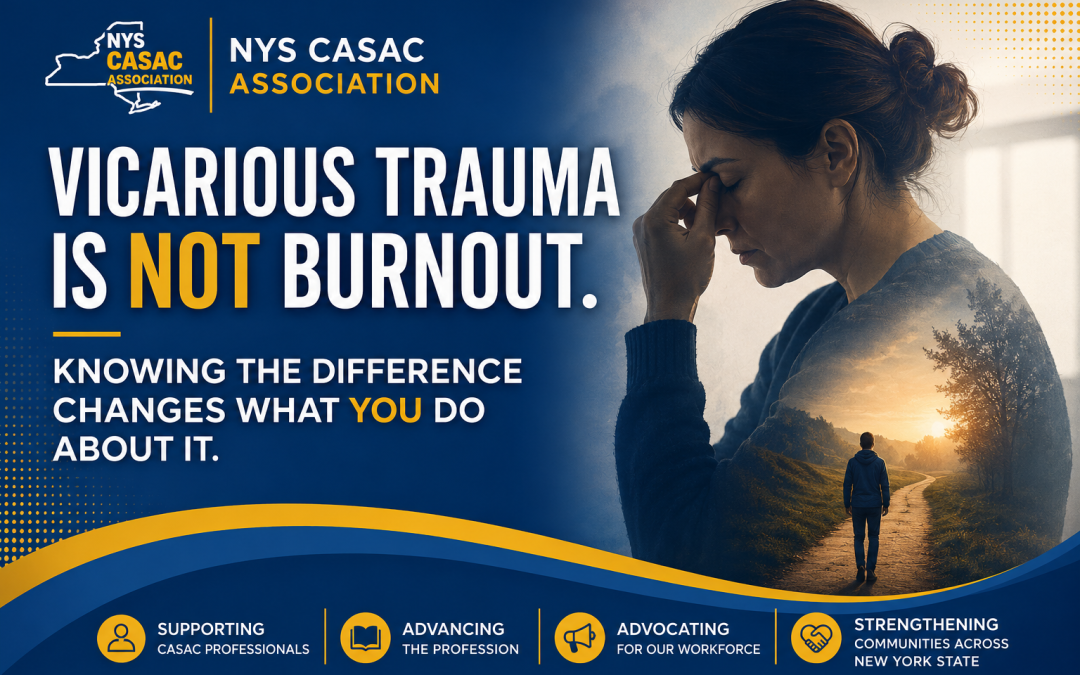
Burnout comes from the conditions of your job. Vicarious trauma comes from the content of your job.
Burnout builds from chronic workplace stress. Caseload size. Paperwork. Pay that does not match the responsibility. Administrative load that eats your clinical time. It is exhaustion that builds over months of doing too much with too little.
The second condition builds from something else entirely. It comes from repeated exposure to your clients’ traumatic material: their assaults, their losses, their overdoses, their childhoods. You absorb it through empathy, session after session, until it changes how you see the world. The symptoms can look like post-traumatic stress disorder, even though nothing happened to you directly. Researchers sometimes call this secondary traumatic stress or vicarious traumatization, but the experience underneath the label is the same.
A counselor can avoid burnout entirely and still develop this. Reasonable caseload, fair pay, supportive supervisor, and the trauma exposure still gets in. That is the part most wellness content skips.
Burnout comes from:
- Caseload size
- Paperwork volume
- Low pay
- Admin overload
This condition comes from:
- Client trauma exposure
- Repeated empathic strain
- Cumulative exposure over time
One is a job problem. The other is an exposure problem.
What Burnout Looks Like in SUD Counseling
Burnout in this field has a familiar shape. You feel drained before your first session even starts.
You dread the next intake. You catch yourself going through the motions in group, present in body, checked out everywhere else. Notes pile up faster than you can close them. You start resenting clients for needing things from you, then feel guilty about the resentment. You count down to the next paid day off like it is the only thing keeping you upright.
None of this means you stopped caring. It means your tank is empty, and the job keeps asking for more than it gives back. A heavier caseload, a hiring freeze, a documentation system that takes longer than the session it documents: any one of these can push a steady counselor into this state within a few months.
Educational Enhancement CASAC Online has a deeper breakdown of burnout’s red flags and root causes if this sounds familiar.
Signs of burnout:
- Caseload dread
- Note pile-up
- Checked-out group sessions
- Resentment toward clients
- Flat affect by Friday
Burnout drains you. It does not change what you believe.
What Vicarious Trauma Looks Like in SUD Counseling
This condition presents differently and is easy to miss.
You start carrying a client’s overdose story home with you, replaying it at 2 a.m. You get hypervigilant in ordinary situations, scanning for danger that is not there. Your trust in people, even people outside the field, starts to erode. You feel numb in moments that used to move you. You may find yourself avoiding intakes with a certain kind of disclosure, not because you are lazy, but because your body remembers the last ten times you heard it. This is not exhaustion. It is your nervous system responding to secondhand exposure the way it would respond to direct exposure.
NIDA’s research on trauma and stress shows what repeated activation of the body’s threat response does over time. The same biological mechanism applies whether the exposure is direct or absorbed secondhand through a client’s account of their own trauma.
Educational Enhancement’s guide to trauma-informed care in substance use counseling covers how to work with what your clients bring into the room. This piece is about something different: what carrying that material home with you does to you over time.
Signs to watch for:
- Intrusive client memories
- Hypervigilance off the clock
- Eroding trust in people
- Emotional numbness
- A shift in worldview
- Avoiding certain disclosures
It does not drain you. It changes you.
Why Standard Self-Care Helps One and Not the Other
Most wellness advice for counselors targets burnout. That is the gap, and it is why so much of it falls flat for CASACs carrying something heavier.
Take a day off. Go to the gym. Set boundaries on your caseload. Use your PTO. All of this helps burnout, because burnout is a resource problem, and rest restores resources. None of it touches vicarious trauma, because that is not a resource problem. It is an exposure problem, and the rest does not process exposure. You can be fully rested and still carry the same intrusive memories you had before the vacation.
A counselor in this state can take a two-week vacation, come back rested, and still flinch at the next disclosure of childhood sexual abuse. The exhaustion lifted. The shift in worldview did not. That gap is exactly why a counselor can follow every piece of standard self-care advice and still feel worse, not better, and then blame themselves for it.
NAADAC’s training on compassion fatigue, burnout, and the strengths-based workplace draws this same line. It treats burnout and trauma exposure as two separate problems that need two separate responses, not one wellness checklist applied to both.
A Two-Minute Self-Check
Use this to sort what you are carrying before you choose a fix.
Lean toward burnout if you:
- Feel tired, not changed
- Dread tasks, not people
- Improve after time off
- Resent the workload
Lean toward vicarious trauma if you:
- Replay client disclosures
- Feel less safe overall
- Stay tired after rest
- Notice a shift in beliefs
If rest fixes it, it was burnout. If it does not, look closer.
One Action for Each
Pick the one that matches what you found above. Treating the wrong one wastes effort you do not have to spare.
For burnout: bring your caseload and admin load to your next supervision meeting, and ask for a workload review, not a pep talk. Name specific numbers. How many open cases, how many hours of documentation, how many sessions back to back with no buffer? OASAS’s workforce development framework exists to address staffing and structural strain in this field, and your supervisor has more room to act on a workload problem than on a vague complaint about feeling tired.
For the second condition, the fix is not rest. It is a structured trauma consultation, separate from general case supervision, where you process the material itself rather than the logistics surrounding it. A good consultation session lets you say out loud what a specific disclosure did to you, without rushing to the next case file. Ask your supervisor for this by name. If your agency does not offer it, find a peer consultation group that does, or raise it with your clinical director as a gap in current support.
Burnout needs less weight on your shoulders. The other condition needs a place to put down what you are carrying.
Know Which One You’re Treating
Burnout and the trauma you absorb from clients will both show up over the course of a career in this field. Knowing which one you are dealing with on any given week determines whether your fix actually works or just buys you a few days of rest before the same symptoms come back.
For the full clinical picture, including how compassion fatigue, burnout, and vicarious traumatization show up together and what to do about each, Educational Enhancement’s Counselor Wellness training covers all three for 6 NAADAC- and CASAC-approved renewal hours. Start there.
Stay Connected With NYS-CASAC Association NEWS
Don’t miss the updates, spotlights, and resources shaping addiction counseling in New York. Join the NYS Association of CASAC Professionals today for full access to announcements, newsletters, and advocacy news that strengthen your voice and career.