New ASAM Youth SUD Criteria guidance for adolescents and transition-aged youth strengthens level-of-care decisions, co-occurring care, and payer accountability.
The American Society of Addiction Medicine (ASAM) has introduced new, youth-specific standards for youth SUD treatment designed to enhance the assessment, admission, and placement processes for adolescents and transition-aged youth dealing with substance use disorder. This marks the first time the ASAM Criteria includes a dedicated volume focused solely on youth, rather than integrating youth guidelines into adult criteria, emphasizing a tailored approach.
What’s new and why it matters for youth SUD
-
A youth-only framework: The new volume is built for adolescents (under 18) and transition-aged youth (ages 16–25), recognizing that development, family context, school systems, and co-occurring mental health needs change the clinical picture.
-
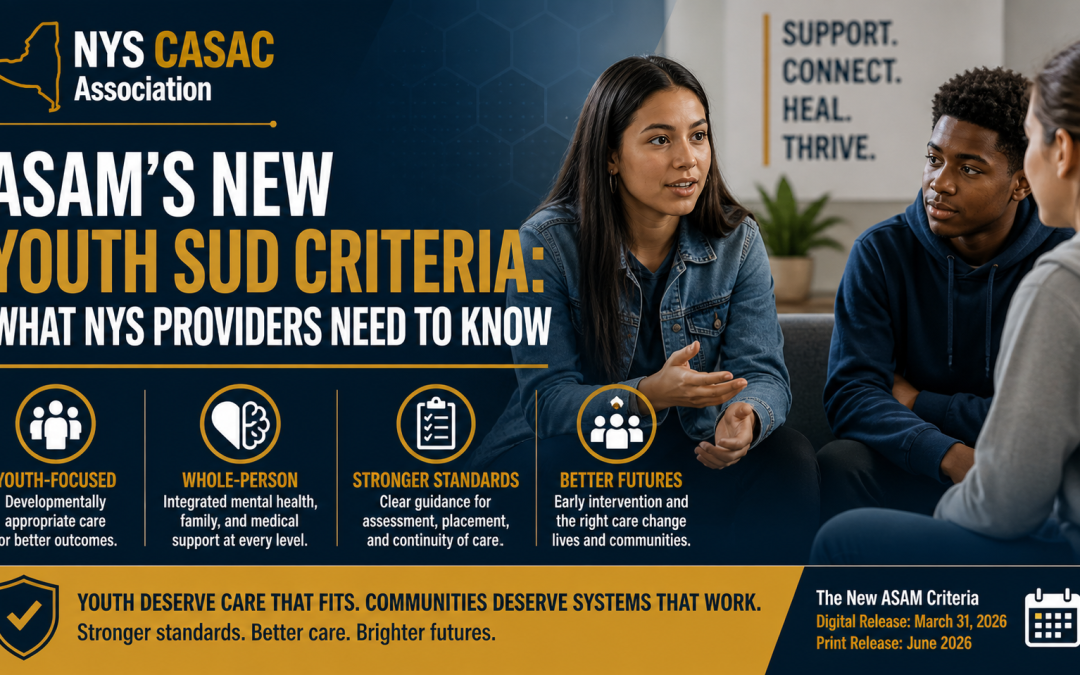
Clear timing and access: ASAM lists the digital release as March 31, 2026, with print available June 2026.
This is the core message: Youth SUD is not “adult SUD, but smaller.”
Youth SUD isn’t adult SUD with a smaller body and a shorter history. You’re working with a brain still under construction, where reward learning, impulse control, and stress regulation are actively developing. That changes everything: how fast use escalates, how strongly peers and environment shape decisions, and how recovery supports have to be built. Treatment has to include family systems, school coordination, and integrated mental health care. If you use adult assumptions, you’ll miss risk, misread “noncompliance,” and lose engagement fast. That’s why youth SUD treatment has to be developmentally matched, not scaled down.
ASAM classifies addiction as a pediatric-onset illness and emphasizes two critical realities:
-
Over 80% of adults with substance use disorder (SUD) began using substances before turning 18.
-
Initiating use before age 15 significantly increases the risk of developing SUD later in life.
-
Therefore, the updated standards advocate for early intervention, emphasizing the importance of addressing issues promptly rather than waiting for problems to worsen.
What the new youth SUD continuum pushes programs to deliver
What the new youth SUD continuum pushes programs to deliver is a higher standard of care that matches how young people actually live, develop, and relapse risk. It’s not “pick a level and hope.” It’s a system built to meet youth where they are, with the right intensity, the right supports, and the right coordination.
1) A chronic-care model, not a short episode
Youth recovery is rarely a straight line. The continuum expects programs to treat SUD as a condition requiring ongoing monitoring, not as one that warrants quick stabilization and discharge. That includes follow-ups, relapse risk check-ins, and medication management when indicated. The message is clear: “stable remission” still needs support.
2) Co-occurring capable care at every level
Teen and young adult SUD doesn’t show up alone. Anxiety, depression, trauma stress, ADHD, and mood instability are common. The continuum pushes programs to integrate mental health care instead of bouncing youth between systems. If you separate SUD from mental health, you create treatment dropouts.
3) Stronger medical integration
The drug supply is more dangerous and more unpredictable. Youth are showing up with complex withdrawal risk, polysubstance use, and medical complications. The continuum expects programs to integrate biomedical and psychosocial services, including appropriate withdrawal management support, rather than treating medical needs as “someone else’s problem.”
4) Whole-family, whole-person services
Youth SUD treatment isn’t just individual therapy. The continuum pushes programs to deliver family services, recovery supports, and risk-reduction services as standard rather than optional add-ons. It also emphasizes responsiveness to the youth and family’s goals and preferences, because engagement is a clinical intervention.
This continuum raises the bar from “youth can fit into adult programming” to “systems must be built for youth realities.”
The policy implication ASAM is signaling
ASAM’s editor leadership is blunt: these standards only work if systems and payers build payment models that can actually deliver youth-appropriate care.
ASAM is basically saying: you can write the best clinical standards in the world, but if money still rewards the wrong things, youth care will stay broken.
Youth-appropriate SUD treatment costs more up front because it requires services that most payment systems underfund or refuse to consistently cover:
-
Family involvement that takes time and coordination
-
Integrated mental health care instead of “refer out and hope.”
-
Care coordination with schools, child welfare, probation, and primary care
-
Step-down and continuing care so relapse risk is managed over months, not just during a short program window
-
Recovery supports and risk reduction that prevent crises before they hit the ER
ASAM’s blunt point is that payers can’t keep paying for short, disconnected episodes and then act surprised when youth drop out, relapse, or cycle through inpatient stays.
If reimbursement doesn’t cover the full continuum, programs will cut corners: fewer clinicians, less family work, weak aftercare, and “graduation” that’s really just discharge.
So the policy implication is urgent: fund the model you say you want. Pay for integrated, developmentally appropriate care, or the standards become a document on a shelf instead of a system that saves lives.
What’s coming next
ASAM notes the Fourth Edition is being released in four volumes, with upcoming volumes focused on justice-involved populations and behavioral addictions (including gambling, internet, and gaming).
ASAM is signaling that the next phase of The ASAM Criteria isn’t just “a refresh.” It’s a deliberate expansion into populations and problems that the treatment system routinely mishandles.
Four volumes mean specialization, not a one-size-fits-all approach.
Instead of forcing every client into adult SUD assumptions, ASAM is building criteria that reflect different pathways into harm, different risks, and different systems that control access to care.
Justice-involved populations:
This volume matters because justice involvement changes everything: coercion vs consent, reentry stress, trauma exposure, relapse risk during transitions, and gaps in MOUD access. Expect stronger guidance on:
-
continuity of MOUD during incarceration and after release
-
coordinating with courts, probation, and reentry services
-
managing withdrawal risk and overdose vulnerability during transitions
-
treatment planning that accounts for legal pressure without turning care into punishment
Behavioral addictions (gambling, internet, gaming):
ASAM is acknowledging what clinicians already see: you can have addiction-like patterns without a drug.
Expect clearer criteria on:
-
How to assess “loss of control” and functional impairment
-
levels of care and when outpatient is not enough
-
co-occurring issues like depression, anxiety, ADHD, trauma, and social isolation
-
family and environmental interventions, especially for youth and young adults
The ASAM is moving the field toward standards that match real life. Different populations need different clinical maps, and these volumes are intended to prevent the system from treating everyone as the same patient.
Source: Tailored Treatment for Adolescents and Transition-Aged Youth with Substance Use Disorder