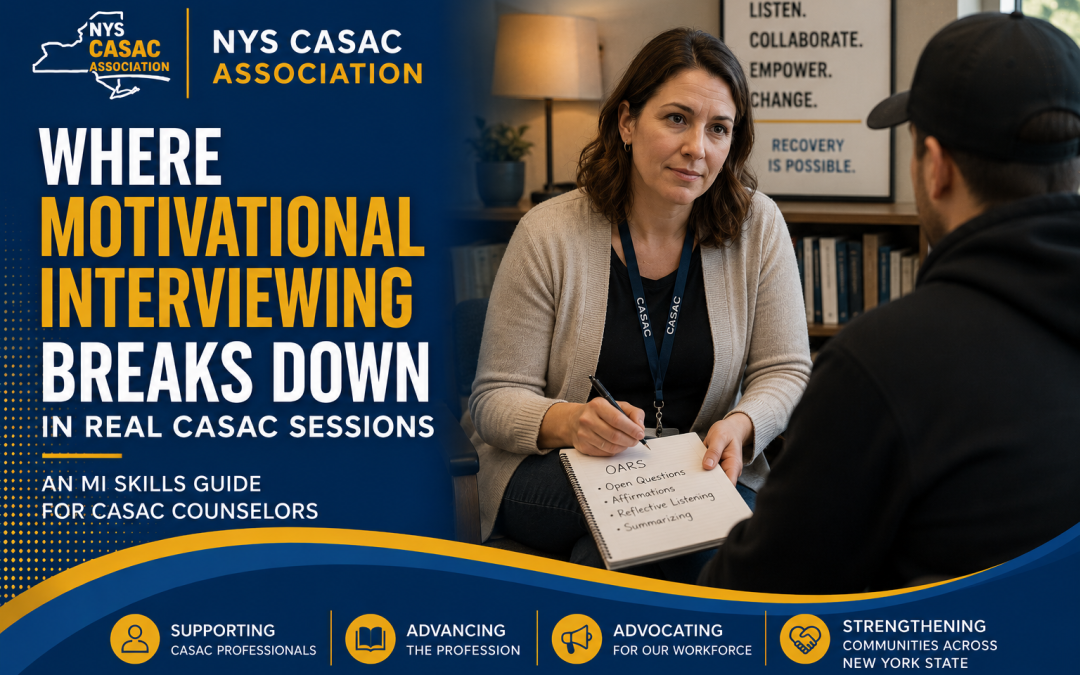
Where Motivational Interviewing Breaks Down in Real CASAC Sessions
Most CASACs learned motivational interviewing during initial training. Fewer have kept the skill sharp. The acronyms stay familiar. OARS, the four processes, the spirit of the approach. What fades is the moment-to-moment use of it, the part that only shows up under pressure in a real session.
This post names the most common motivational interviewing mistakes CASACs make once the training binder closes. Where the righting reflex creeps in. Where the four MI processes stall. A one-week drill that rebuilds reflective listening. And how the whole skill set ties back to the 12 Core Functions OASAS already requires you to perform.
The Righting Reflex in a Real SUD Session
A patient says they are thinking about cutting back, not stopping. The fastest response in your head is the wrong one. Tell them why full abstinence works better. List the risks of half measures. Offer the solution before they finish the sentence.
That instinct has a name. Miller and Rollnick called it the righting reflex, the urge to fix what sounds unfinished or wrong. It comes from a good place. Counselors want patients well. The problem is timing, not intent.
The righting reflex shows up as:
- Correcting before the patient finishes talking
- Offering solutions to problems not yet explored
- Arguing for change, the patient has not claimed yet
- Treating ambivalence as a problem to clear away
Picture a patient who says drinking helps them sleep after a double shift. A counselor running on the righting reflex jumps straight to sleep hygiene tips and a warning about tolerance. The patient stops talking. They already know the warning. What they needed was a reflection of the exhaustion underneath the drinking, not a lecture about it.
Every one of those corrective moves can trigger the opposite of what a counselor wants. The patient defends their current behavior to you out loud. Psychologists call that sustained talk, and counselors often create it themselves by pushing too early. It is one of the most common motivational interviewing mistakes in early recovery work, and one of the easiest to catch once you know the pattern.
NAADAC’s code of ethics names autonomy as a guiding principle of the field. It defines autonomy as the freedom to choose one’s own destiny. The righting reflex is what it looks like when a counselor quietly overrides that principle, one well-meaning suggestion at a time. Catching the urge before it becomes a sentence is the actual skill.
The Four MI Processes and Where CASACs Get Stuck
Motivational interviewing runs through four stages. Engaging, focusing, evoking, and planning. They build on each other in order, and skipping ahead is where most motivational interviewing mistakes start.
Where each stage tends to break down:
- Engaging: rushed past in the first five minutes
- Focusing: skipped, so the session has no clear target
- Evoking: replaced with advice instead of the patient’s own reasons
- Planning: introduced before the patient has expressed any readiness
Evoking is the stage counselors cut short most often. It asks you to draw out the patient’s own motivations in their words, rather than supplying yours. Done well, evoking sounds like a question, such as what worries them most about where things are headed, followed by silence long enough for a real answer. Done poorly, it sounds like a counselor answering that question for them.
A counselor under time pressure jumps straight to planning. The patient nods along to a plan that was never really theirs, and it falls apart by the next session. That gap between a stated plan and a felt plan is where relapse conversations usually start, not at the relapse itself.
SAMHSA’s guidance on enhancing motivation in substance use treatment walks through each step in detail, with evidence explaining why order matters. Treat the four stages as a sequence, not a menu, and most session derailments stop before they start.
A One-Week Drill to Sharpen Reflective Listening
Reflective listening is the skill that erodes fastest without practice. It is also the easiest one to rebuild on your own, without a workshop or a supervisor watching.
The drill, run for one week:
- Count every question you ask a patient in session
- Follow each question with one reflection before your next question
- Aim for two reflections per question by week’s end
- Write down one reflection daily that surprised the patient
Keep a small tally on a notepad or your phone between patients. Two columns. Questions on one side, reflections on the other. Most counselors who try this for the first time are surprised by how lopsided the count looks by Wednesday.
That last step matters most. A reflection that lands shows the patient you heard the meaning under their words, not just the words. A few session habits, built for exactly this kind of daily practice, can sharpen the same muscle outside of session hours, too.
Counselors who track their own ratio for a week almost always find they ask more than they reflect. Skipping reflection is one of the quieter motivational interviewing mistakes because it never looks wrong in the moment. Naming the pattern out loud is most of the fix.
How MI Fits Into the 12 Core Functions
Motivational interviewing is not a separate add-on to your job. It runs through several of the 12 Core Functions OASAS requires every CASAC to demonstrate, most directly in counseling and treatment planning.
MI shows up inside core function work as:
- Counseling: every reflection and open question you use
- Treatment planning: goals the patient states in their own words
- Crisis intervention: de-escalation built on accurate empathy
- Client education: information offered, not imposed
A treatment plan goal written from evoked language survives review better than one written from a counselor’s assumption. A closer look at what treatment plan documentation now requires shows how directly MI language and OASAS documentation standards connect. The skill and the paperwork are not two separate jobs.
Most motivational interviewing mistakes trace back to one of these four functions running on autopilot rather than receiving attention. The fix is rarely new information. It is slowing down inside work you already know how to do.
Precision Over Acronyms
None of this asks you to relearn motivational interviewing from a textbook. It asks you to notice the exact second the righting reflex takes over, slow down at evoking, and reflect more than you ask. Most motivational interviewing mistakes hide in that one missed beat.
Person-centered counseling habits and the kind of listening that resists assumptions both feed the same skill this post is about. The acronyms were never the hard part. Knowing them was never the same as using them under pressure.
This course on the foundations of counseling walks through ambivalence, the therapeutic alliance, and the listening skills behind every stage of MI. Twenty NAADAC- and CASAC-approved hours, built for counselors who already know the model and want to use it with more precision.
Stay Connected With NYS-CASAC Association NEWS
Don’t miss the updates, spotlights, and resources shaping addiction counseling in New York. Join the NYS Association of CASAC Professionals today for full access to announcements, newsletters, and advocacy news that strengthen your voice and career.