Collaborative Documentation for CASACs
You finish your last client at 5:00.
Your counseling day is over.
Your documentation is not.
Three progress notes still need writing. A treatment plan needs updating. An assessment requires clarification before tomorrow’s utilization review. The workday quietly stretches another hour.
That is a work injury.
For many CASACs, documentation creates more stress than the counseling itself. Collaborative documentation offers one practical way to change that. It is not another paperwork requirement. It is a different way of completing the paperwork you already have to do.
Documentation should happen during treatment
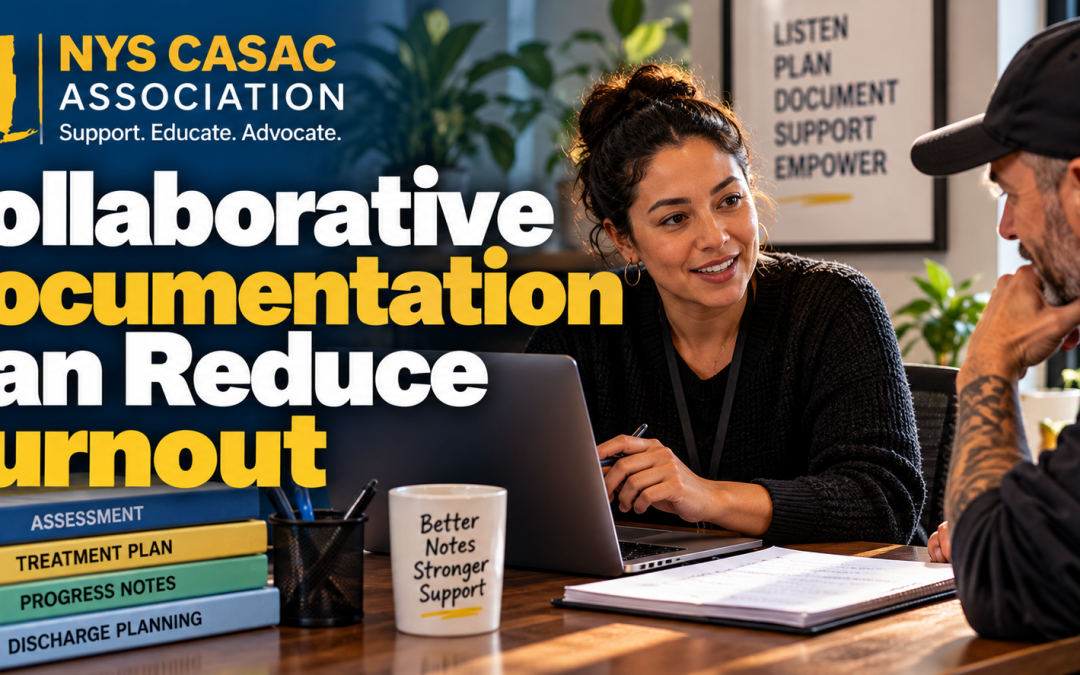
Collaborative documentation means writing portions of the clinical record with the client during the session. The counselor asks questions, summarizes what was discussed, enters the information into the record, and invites the client to confirm its accuracy.
The counselor remains responsible for the documentation.
The client becomes an active participant instead of someone discussed after leaving the room.
That small change shifts the entire process.
Clients become part of the treatment plan
Many treatment plans fail for one simple reason.
Clients never see them.
Goals are written after the appointment. Objectives sound clinical instead of personal. Weeks pass before anyone looks at them again.
Collaborative documentation changes that.
Instead of asking what happened and writing the answer later, you document together.
“What goal feels most important this week?”
“What got in the way?”
“What would success look like before our next appointment?”
The treatment plan becomes more relevant immediately. Clients hear their own words reflected in the record. Small misunderstandings are corrected before they become permanent documentation.
That builds traction.
Progress notes become easier to write
Many counselors spend more time remembering the session than documenting it.
That creates problems.
Details disappear. Quotes become approximations. Clinical observations become shorter. Notes begin sounding identical from client to client.
Writing during the session solves much of this.
You document while the information is still fresh. You confirm dates immediately. You verify goals. You record barriers while the discussion is happening.
The finished note reflects the actual conversation, not your memory of it.
OASAS reviewers look for consistency
During an OASAS chart review, reviewers don’t simply count completed notes.
They are following the clinical story.
Does the assessment identify a need?
Does the treatment plan address that need?
Do the progress notes document work toward that goal?
Does the discharge summary reflect the client’s progress?
The documentation should connect from beginning to end.
Broken links create problems.
Collaborative documentation naturally strengthens those connections because goals, interventions, and client responses are reviewed together throughout treatment, not reconstructed later.
If you want a deeper look at what reviewers examine during chart reviews, see our guide on Documentation That Actually Survives an OASAS Audit.
Medical necessity becomes easier to demonstrate
Every documented service should answer one question.
Why was today’s session medically necessary?
That answer should appear throughout the record.
The assessment identifies the clinical need.
The treatment plan explains what will be addressed.
The progress note documents the intervention.
The client’s response demonstrates why continued treatment remains appropriate.
Collaborative documentation keeps those pieces aligned because the conversation itself focuses on measurable progress instead of generic summaries.
That is documentation doing its job.
A simple workflow
Collaborative documentation does not require rewriting your counseling style.
It requires small adjustments.
A practical workflow looks like this.
- Review the previous goal together.
- Ask what changed since the last visit.
- Type brief notes during the discussion.
- Read your summary aloud.
- Confirm accuracy with the client.
- Agree on the next objective before ending the session.
Most counselors discover this saves time instead of adding time.
Common mistakes
Collaborative documentation is not typing continuously while the client talks.
Eye contact still matters.
Listening still matters.
Avoid these habits.
- Turning the session into data entry.
- Copying previous notes.
- Using vague language.
- Writing objectives without client input.
- Documenting after the client leaves when you could have done it together.
The goal is conversation first.
Documentation follows naturally.
Technology can help
Modern electronic health records make collaborative documentation easier than ever.
A laptop positioned where both people can see the screen invites discussion. Tablets allow quick updates during treatment planning. Voice recognition software can capture summaries immediately after key discussions.
Technology should support the clinical relationship.
It should never replace it.
Burnout often starts after the session ends
Counselor burnout rarely begins during a meaningful clinical conversation.
It begins afterward.
Late evenings. Documentation backlogs. Charts waiting until tomorrow. Notes written from memory. Constant pressure to catch up.
Those small loads accumulate.
Collaborative documentation reduces that burden one session at a time. The paperwork becomes part of treatment instead of something that waits until after treatment ends.
Not perfect.
Better.
I have worked in programs where the paperwork felt endless. I have also seen what changes when counselors stop treating documentation as something separate from counseling. Clients become more involved. Records become stronger. Counselors leave with fewer unfinished charts. That is not simply better documentation. It is a better way to practice.
Join the NYS Association of CASAC Professionals.
Advance your career. Unify with peers. Advocate for the profession. Gain access to training, certification support, and a statewide network that strengthens both you and the CASAC workforce